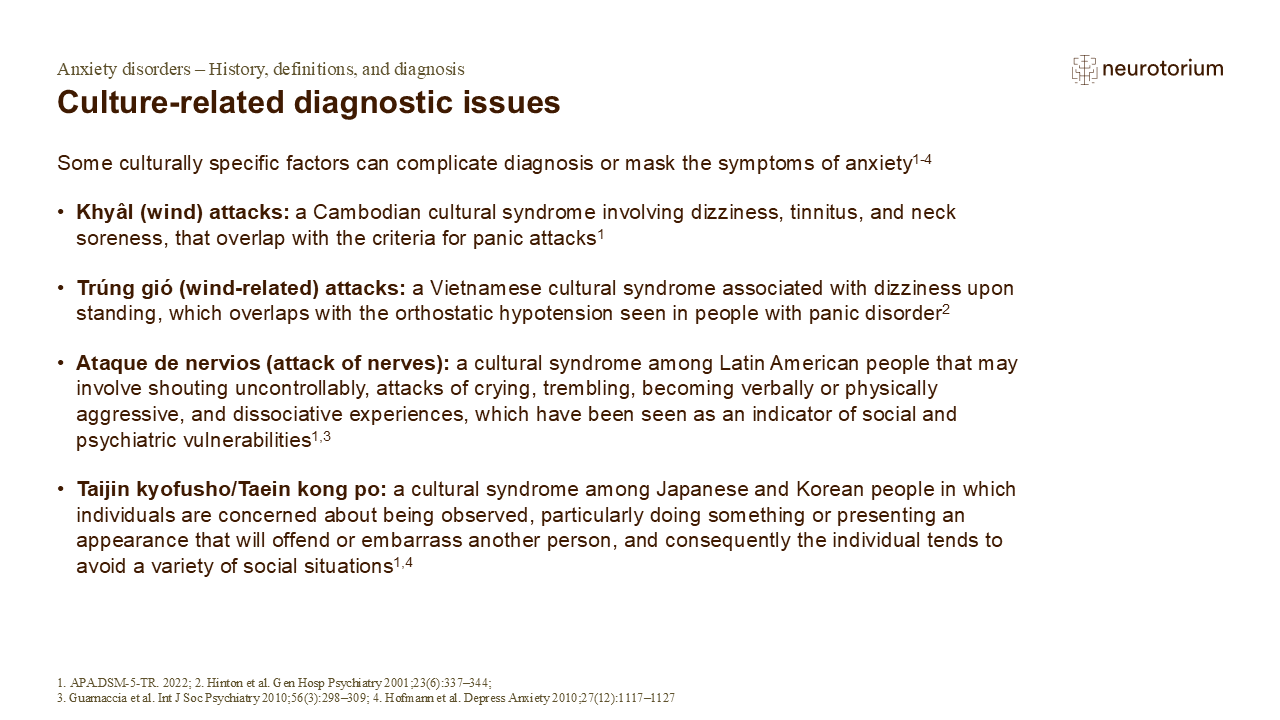
Specific factors seen in different cultural groups can complicate or mask symptoms of anxiety, such as the ‘attacks of wind’ observed in some refugee groups, and a cultural concern of disapproving social gaze seen in some people from Japan.1-4 These culture-related diagnostic issues are explicitly mentioned in DSM-5-TR and ICD-11.1,5
References:
1.American Psychiatric Association. Diagnostic and Statistical Manual of Mental Disorders. Fifth Edition – text revision. © American Psychiatric Association, 2022.
2.Hinton D, Chau H, Nguyen L, et al. Panic disorder among Vietnamese refugees attending a psychiatric clinic: prevalence and subtypes. Gen Hosp Psychiatry 2001; 23 (6): 337–344.
3.Guarnaccia PJ, Lewis-Fernandez R, Martinez Pincay I, et al. Ataque de nervios as a marker of social and psychiatric vulnerability: results from the NLAAS. Int J Soc Psychiatry 2010; 56 (3): 298–309.
4.Hofmann SG, Anu Asnaani MA, Hinton DE. Cultural aspects in social anxiety and social anxiety disorder. Depress Anxiety 2010; 27 (12): 1117–1127.
5.World Health Organization. International Classification of Diseases – 11th edition. Available at: https://icd.who.int/en. Accessed July 2025.