

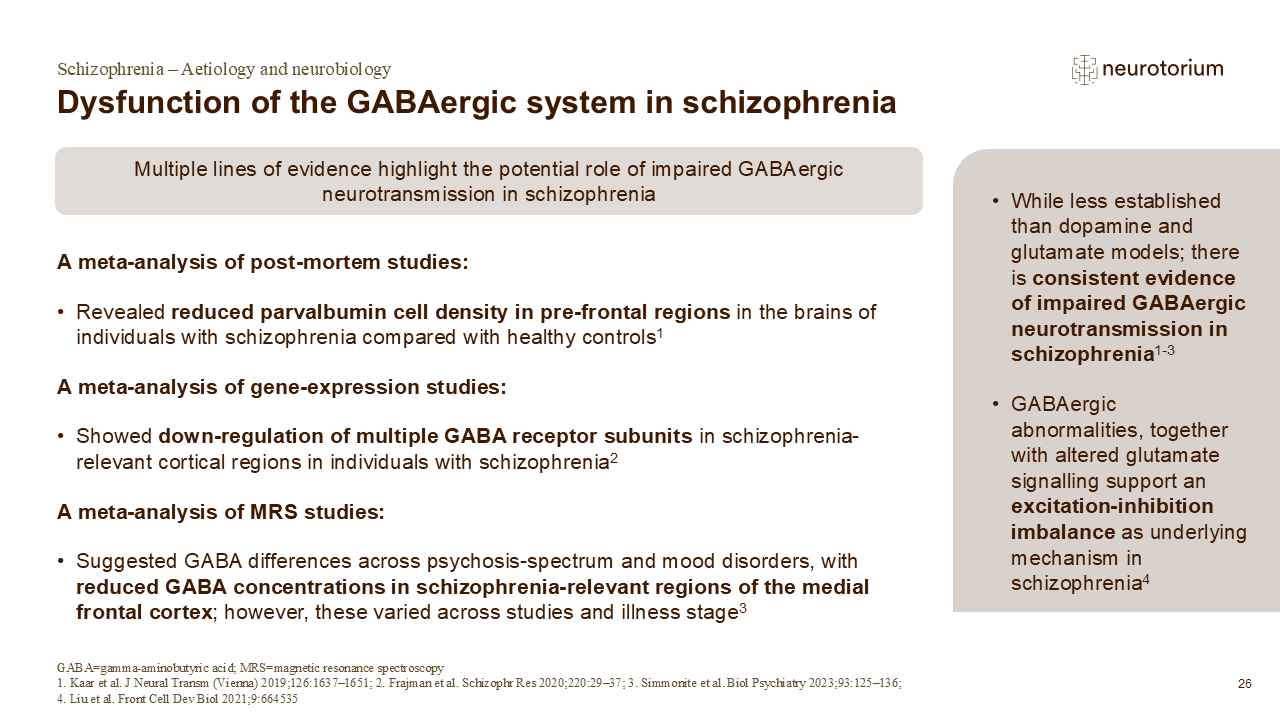
Parvalbumin interneurons are GABAergic neurons that provide inhibitory control of cortical and subcortical circuits, which have been linked to working memory and other cognitive processes.1
Neural information consists of both excitatory signals from glutamatergic neurons and inhibitory signals originating from GABAergic interneurons.4 In a healthy brain, excitatory and inhibitory information is balanced through multiple coordinated developmental processes.4 Maintenance of the balance of excitatory and inhibitory signals is critical for the development and function of cortical microcircuits and neural networks.4 Disruption of this finely tuned excitatory-inhibitory balance has been proposed as a hypothesis providing insights into the neuropathology underlying schizophrenia.4
Abbreviations: GABA=gamma-aminobutyric acid
References:
1. Kaar SJ, Angelescu I, Marques TR, et al. Pre-frontal parvalbumin interneurons in schizophrenia: a meta-analysis of post-mortem studies. J Neural Transm (Vienna) 2019; 126: 1637–1651.
2. Frajman A, Maggio N, Muler I, et al. Gene expression meta-analysis reveals the down-regulation of three GABA receptor subunits in the superior temporal gyrus of patients with schizophrenia. Schizophr Res 2020; 220: 29–37.
3. Simmonite M, Steeby CJ, Taylor SF, et al. Medial frontal cortex GABA concentrations in psychosis spectrum and mood disorders: a meta-analysis of proton magnetic resonance spectroscopy studies. Biol Psychiatry 2023; 93: 125–136.
4. Liu Y, Ouyang P, Zheng Y, et al. A selective review of the excitatory-inhibitory imbalance in schizophrenia: underlying biology, genetics, microcircuits, and symptoms. Front Cell Dev Biol 2021; 9: 664535.