

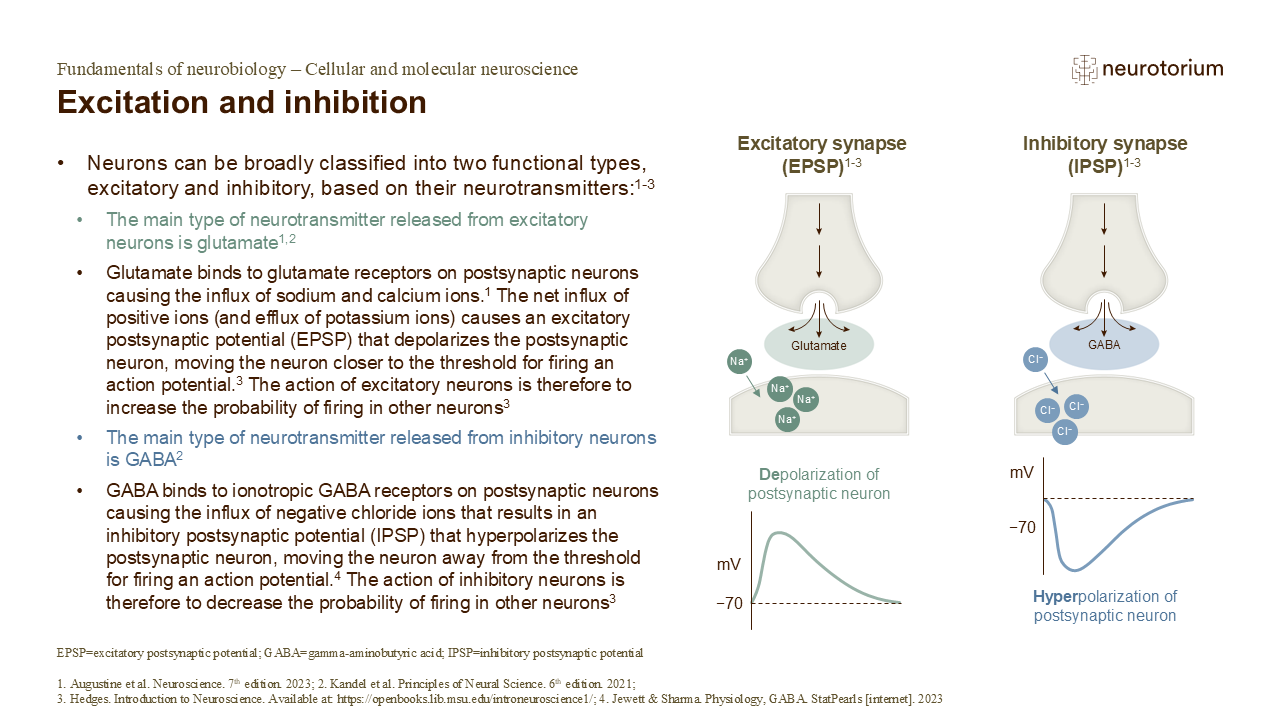
The balance between excitation and inhibition in the brain is a fundamental principle of neural circuit function.5 It refers to the dynamic equilibrium between excitatory signals, which increase the likelihood of neuronal firing (mainly mediated by glutamate), and inhibitory signals, which decrease that likelihood (primarily mediated by GABA).5 Maintenance of the excitation–inhibition balance of the brain is crucial for its functioning.5 Indeed, many neurological and psychiatric disorders can involve a disruption to the excitation–inhibition balance, including epilepsy, and schizophrenia.5
References:
1.Neurotransmitters and their receptors. In: Augustine GJ, Groh J, Huettel S, et al. (eds). Neuroscience. 7th edition. Oxford University Press, 2023.
2.Neurotransmitters. In: Kandel ER, Koester JD, Mack SH, Siegelbaum SA (eds). Principles of Neural Science. 6th edition. McGraw-Hill, 2021.
3.Hedges V. Electrical activity in neurons. In: Introduction to Neuroscience. Available at https://openbooks.lib.msu.edu/introneuroscience1/. Michigan State University Libraries.
4.Jewett BE, Sharma S. Physiology, GABA. StatPearls [internet]. 2023.
5.Tatti R, Haley MS, Swanson OK, et al. Neurophysiology and regulation of the balance between excitation and inhibition in neocortical circuits. Biol Psychiatry 2016; 81 (10): 821–831.