
Both primary care and secondary care physicians contribute to dementia diagnosis. Primary care is involved in:1
- exploring the patient’s ideas and concerns about their symptoms; excluding any potentially treatable or reversible illnesses
- referring for specialist assessment those with unusual symptoms or at significant risk
- discussing and explaining to the patient the possible investigations with secondary care
- ensuring that individuals with mild cognitive impairment (MCI) are followed up and referred for specialist assessment, if necessary
Secondary care is involved in:1
- defining the dementia subtype
- managing more complex cases
- distinguishing which individuals with MCI are at greatest risk of developing dementia and are most in need of follow-up
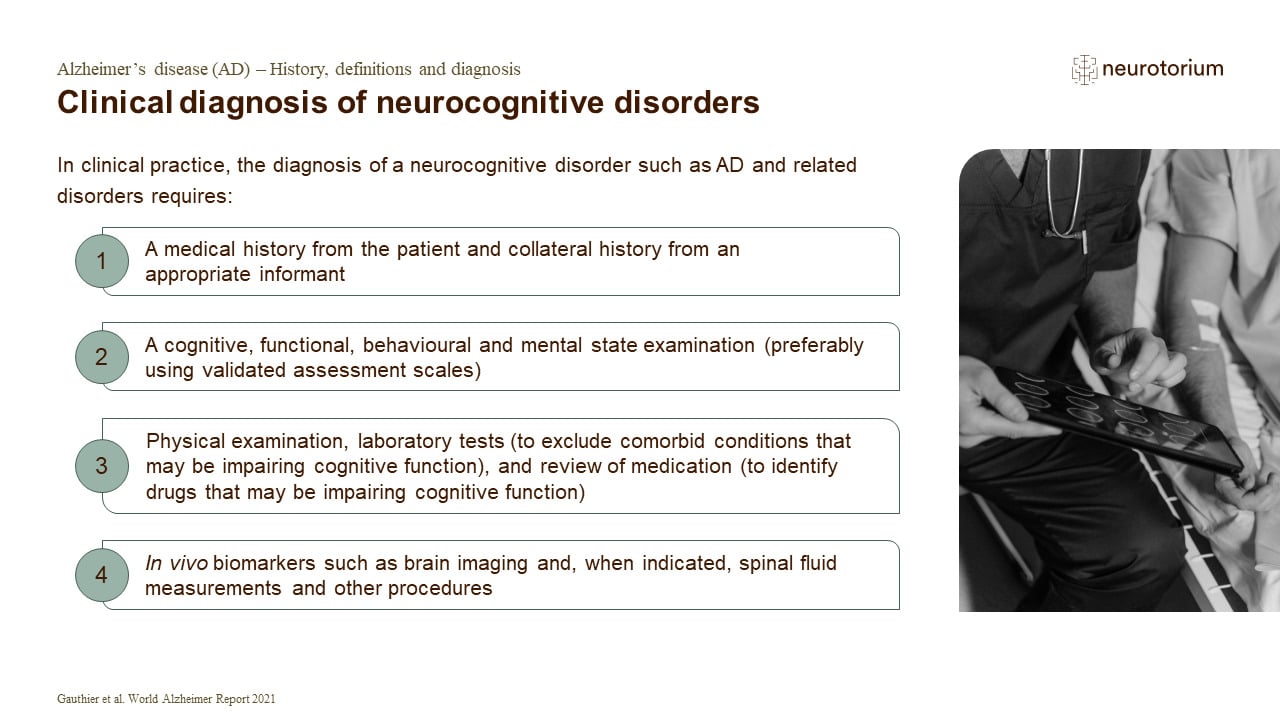
Initial assessment in primary care should include a careful history from the individual with dementia and the main carer, with a focus on disturbances of cognitive function and activities of daily living.1 Physical examinations allow identification of any focal neurological signs and the exclusion of visual or auditory problems.1 Most countries suggest that the initial visit should be with the regular primary care physician, and if the individual does not have one, a visit to a clinic with several primary care physicians may be beneficial.1 Primary care provides the individual with cognitive issues and/or their carer with a familiar, person-centered environment to discuss any worries and concerns, both before and after diagnosis.1 For more complex cases, referral to a specialist such as a geriatrician, neurologist, psychiatrist or neuropsychologist may be required.1 However, before a referral to secondary care, cognitive assessments and baseline investigations (e.g., blood tests, X-rays, and ECGs, if required) must be conducted.1 Cognitive assessments include using tools such as the 10-point cognitive screener (10-CS), General Practitioner Assessment of Cognition (GPCOG), 6-item Cognitive Impairment Test (6CIT), and the Mini-Cog Assessment Instrument or Memory Impairment Screen (MIS).1,2
References:
1.Gauthier S, Rosa-Neto P, Morais JA, Webster C. World Alzheimer Report 2021: Journey through the diagnosis of dementia. Available at: https://www.alzint.org/u/World-Alzheimer-Report-2021.pdf. Accessed 15 November 2023.
2.National Institute for Health and Care Excellence. Dementia: assessment, management and support for people living with dementia and their carers. 20 June 2018. Available at: https://www.nice.org.uk/guidance/ng97/resources/dementia-assessment-management-and-support-for-people-living-with-dementia-and-their-carers-pdf-1837760199109. Accessed 15 November 2023.