

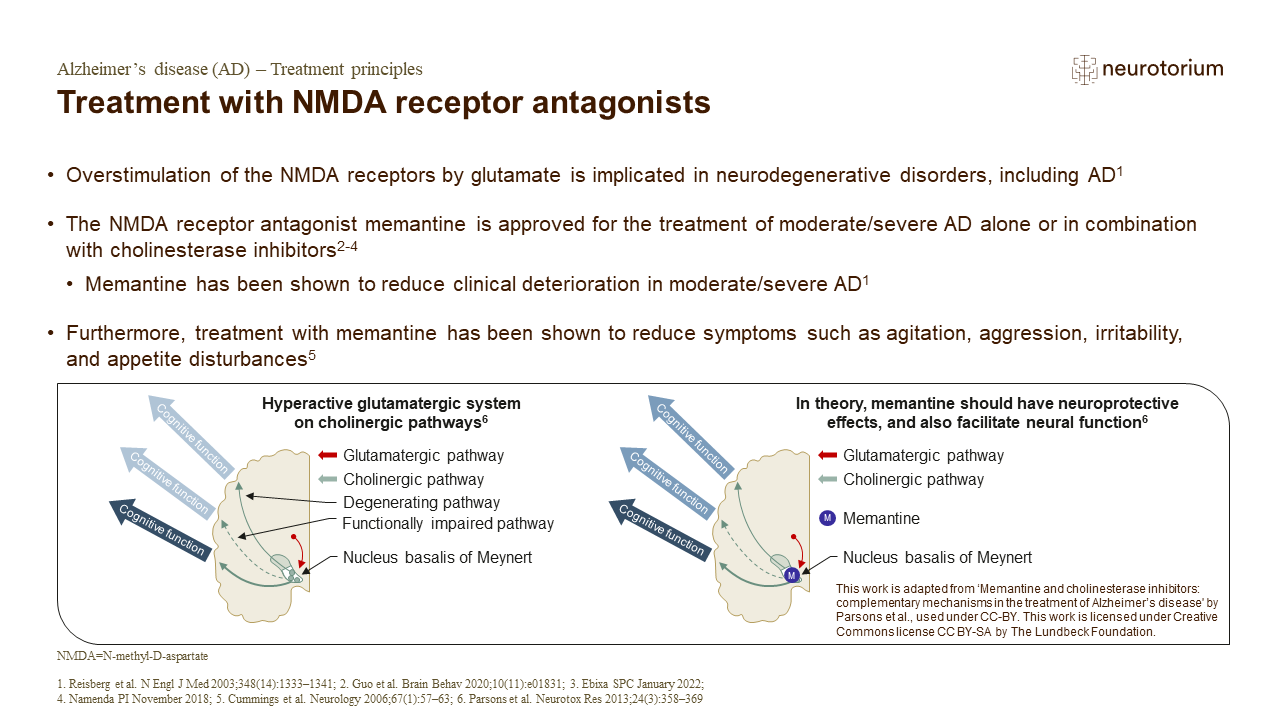
The main neurotransmitter in the brain is glutamate.7,8 Overstimulation of the glutamatergic system may result in neuronal damage, known as excitotoxicity, which subsequently results in neuronal calcium overload.9 Included in the many postsynaptic receptors stimulated by glutamate are the NMDA receptors, which have been implicated in memory processes and the pathogenesis of AD.9-11 Memantine, an NMDA receptor antagonist, was first approved in 2002 by the European Agency for the Evaluation of Medical Products (EMEA) for the treatment of ‘moderately severe to severe AD’ which (later expanded to include ‘moderate-to-severe AD’),3,12 and in 2003 by the US Food and Drug Administration (FDA) for the treatment of ‘moderate-to-severe AD’.4 Additionally, memantine is also widely used off-label for the treatment of mild AD.13 In a systematic literature review, memantine (with or without concomitant cholinesterase inhibitors) showed a small clinical benefit versus placebo for moderate-to-severe AD, with evidence that the presence of concomitant cholinesterase inhibitors did not impact the difference between memantine and placebo (with the exception of behaviour and mood, and cognitive function outcomes).13 The clinical benefit of memantine improves thinking, the ability to carry out normal activities of daily living, and the severity of behaviour and mood problems.13 Overall, memantine was found to be well tolerated in patients with moderate-to-severe AD, but may cause dizziness in some people.13 In a network meta-analysis, memantine plus donepezil demonstrated a superior outcome for cognition, global assessment, daily activities, and neuropsychiatric symptoms, but lower acceptability compared with memantine monotherapy and placebo.2 Results of the network meta-analysis concluded that combination therapy may provide a more cost-effective approach than donepezil monotherapy as memantine may slow the progression of AD.2
3. European Medicines Agency. Ebixa Summary of product characteristics. 5 January 2022. Available at: www.ema.europa.eu/en/documents/product-information/ebixa-epar-product-information_en.pdf. Accessed 11 August 2023.
4. NAMENDA® (memantine hydrochloride) Prescribing Information. Available at: https://www.accessdata.fda.gov/drugsatfda_docs/label/2018/021487s025lbl.pdf. Accessed 11 August 2023.
7. Fonnum F. Glutamate: a neurotransmitter in mammalian brain. J Neurochem 1984; 42 (1): 1–11.
12. European Medicines Agency. Ebixa scientific discussion. Available at: https://www.ema.europa.eu/en/documents/scientific-discussion/ebixa-epar-scientific-discussion_en.pdf. Accessed 18 August 2023.