

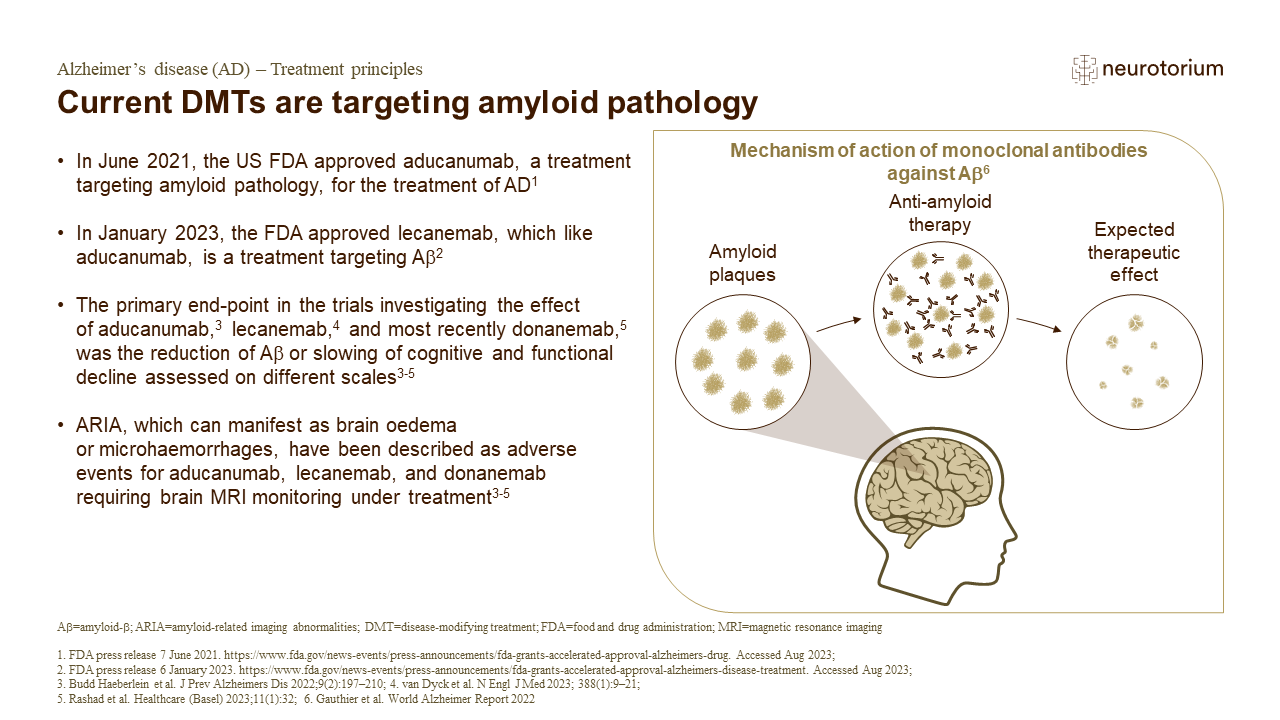
Several AD therapies under investigation target Aβ or its aggregates and can generally be divided into four therapeutic aims: 1) to reduce Aβ generation; 2) to enhance degradation and clearance of Aβ and its aggregates; 3) to neutralize soluble Aβ monomers or the resulting toxicity; 4) to directly inhibit Aβ aggregation.7 As of August 2023, aducanumab and lecanemab are the only two FDA approved antibody-based drugs, while investigation of 38 therapies have been discontinued due to ineffectiveness or toxic side effects.7-9
Aducanumab has been shown to reduce Aβ plaques in imaging studies,10 while lecanemab has been shown to successfully reduce brain amyloid, and slow cognitive decline.11 Several trials of Aβ targeting therapies have failed due to lack of sufficient specificity and accurate translational models, loss of Aβ physiological homeostasis, and failure to be administered during the best therapeutic window.7 As a result of the failed trials, debate on the amyloid hypothesis has increased, and has raised concerns about whether research has been properly directed.7 β-secretase 1 (BACE1) and γ-secretase are involved in Aβ production.7 BACE inhibitors and γ-secretase inhibitors/modulators aim to target Aβ production, at the early stage of the amyloid cascade.7 These inhibitors may slow down plaque formation in patients with AD, but have not been found to clear existing Aβ plaques or reduce the toxic events that have already been initiated by Aβ aggregates.7 Therefore, combination therapy that targets multiple AD pathologies may provide a more effective approach than monotherapy.7 In addition, availability of biomarkers would allow identification of patients with preclinical AD so that treatments such as mechanism-based therapy may be used to slow down the disease.7
References:
1. FDA press release 7 June 2021. FDA grants accelerated approval for Alzheimer’s drug. Available at: FDA Grants Accelerated Approval for Alzheimer’s Drug | FDA. Accessed 14 August 2023.
2. FDA press release 6 January 2023. FDA grants accelerated approval for Alzheimer’s disease treatment. Available at: FDA Grants Accelerated Approval for Alzheimer’s Disease Treatment | FDA. Accessed 14 August 2023.
6. Gauthier S, Webster C, Servaes S, et al. World Alzheimer Report 2022: Life after diagnosis: navigating treatment, care and support. Available at: https://www.alzint.org/u/World-Alzheimer-Report-2022.pdf. Accessed October 2023.
8. FDA press release 6 July 2023. FDA converts novel Alzheimer’s disease treatment to traditional approval. Available at: https://www.fda.gov/news-events/press-announcements/fda-converts-novel-alzheimers-disease-treatment-traditional-approval. Accessed 9 August 2023.
9. FDA press release 6 June 2021. FDA’s decision to approve new treatment for Alzheimer’s disease. Available at: https://www.accessdata.fda.gov/drugsatfda_docs/appletter/2021/761178Orig1s000ltr.pdf. Accessed 9 August 2023.