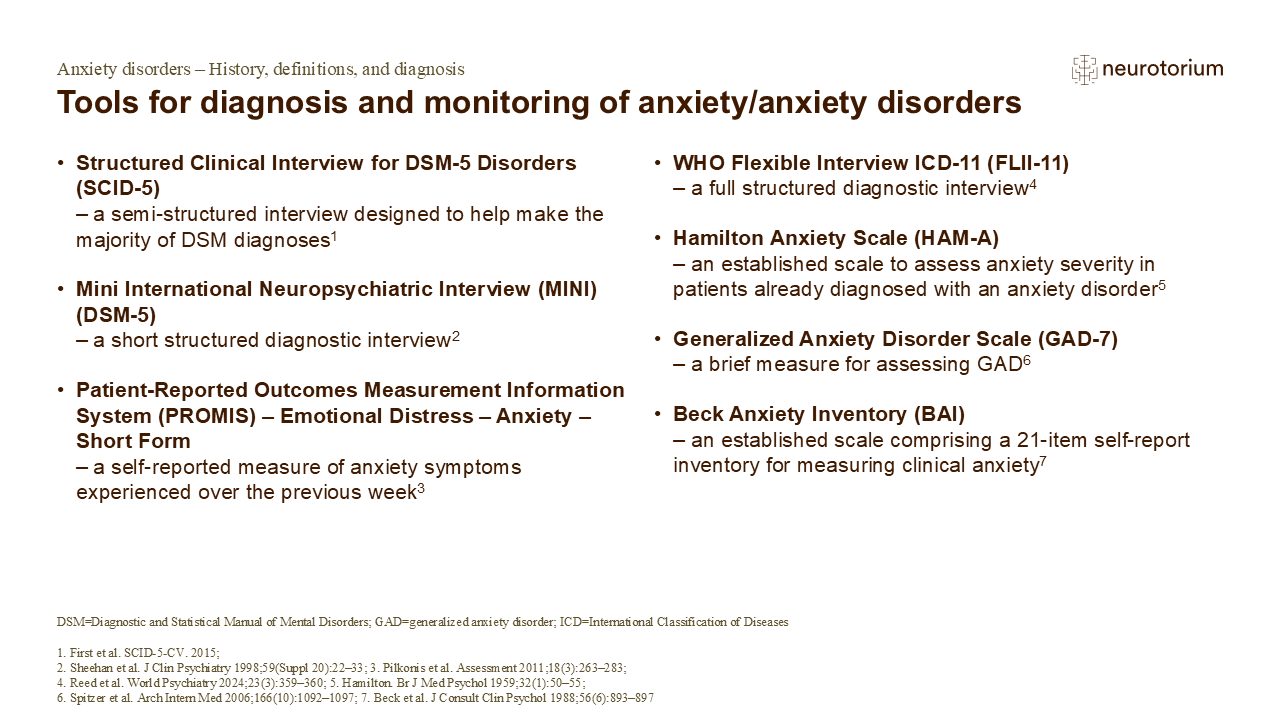
Many tools and scales are available to diagnose and monitor anxiety, some of these are listed on the slide.
References:
1.First MB, Williams JB, Karg RS, Spitzer RL. Structured Clinical Interview for DSM-5 disorders: SCID-5-CV clinician version. American Psychiatric Association Publishing. 2015.
2.Sheehan DV, Lecrubier Y, Sheehan KH, et al. The Mini-International Neuropsychiatric Interview (M.I.N.I.): the development and validation of a structured diagnostic psychiatric interview for DSM-IV and ICD-10. J Clin Psychiatry 1998; 59 (Suppl 20): 22–33.
3.Pilkonis PA, Choi SW, Reise SP, et al. Item banks for measuring emotional distress from the Patient-Reported Outcomes Measurement Information System (PROMIS®): depression, anxiety, and anger. Assessment 2011; 18 (3): 263‒283.
4.Reed GM, Maré KT, First MB, et al. The WHO Flexible Interview for ICD-11 (FLII-11). World Psychiatry 2024; 23 (3): 359–360.
5.Hamilton M. The assessment of anxiety states by rating. Br J Med Psychol 1959; 32 (1): 50–55.
6.Spitzer RL, Kroenke K, Williams JB, Löwe B. A brief measure for assessing generalized anxiety disorder: the GAD-7. Arch Intern Med 2006; 166 (10): 1092–1097.
7.Beck AT, Epstein N, Brown G, Steer RA. An inventory for measuring clinical anxiety: psychometric properties. J Consult Clin Psychol 1988; 56 (6): 893–897.