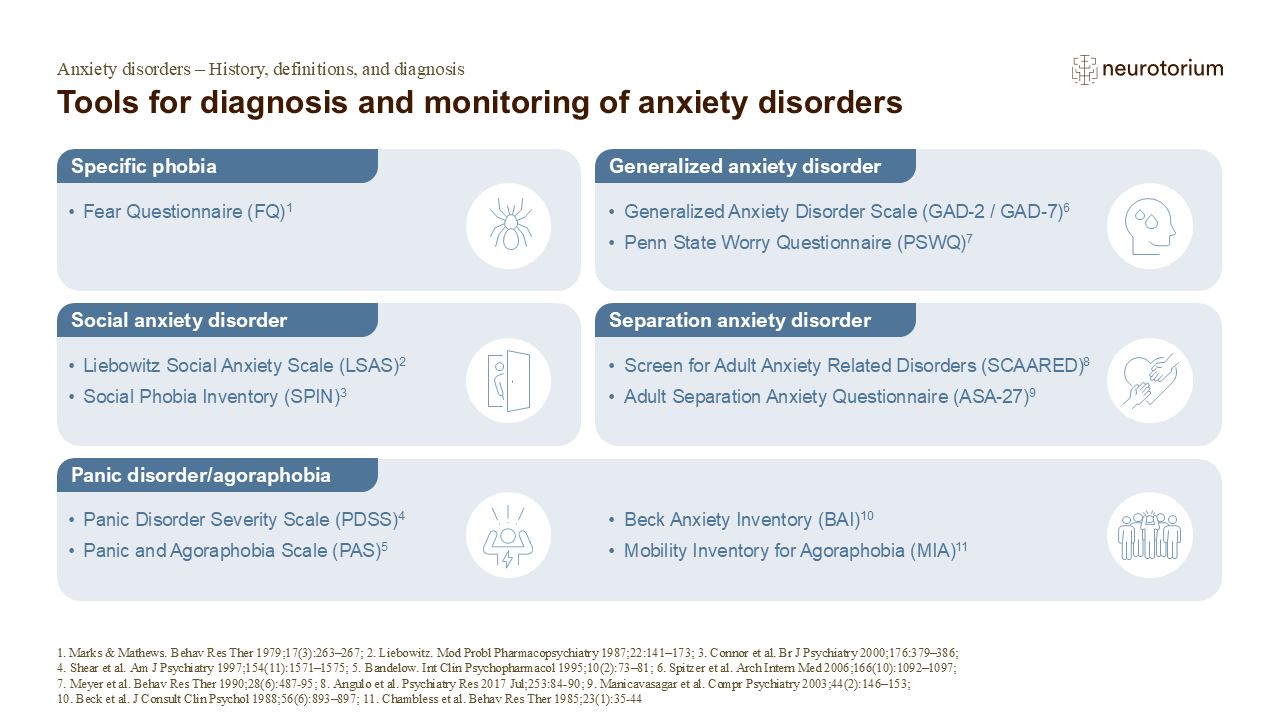
Many tools and scales are available to diagnose and monitor anxiety disorder, some of these are listed on the slide. Some of these scales are established, having been developed in the last century,1,2 whereas others are more modern.3,8
References:
1.Marks IM, Mathews AM. Brief standard self-rating for phobic patients. Behav Res Ther 1979; 17 (3): 63–267.
2.Liebowitz MR. Social phobia. Mod Probl Pharmacopsychiatry 1987; 22: 141–173.
3.Connor KM, Davidson JR, Churchill LE, et al. Psychometric properties of the Social Phobia Inventory (SPIN). New self-rating scale. Br J Psychiatry 2000; 176: 379–386.
4.Shear MK, Brown TA, Barlow DH, et al. Multicenter collaborative panic disorder severity scale. Am J Psychiatry 1997; 154 (11): 1571–1575.
5.Bandelow B. Assessing the efficacy of treatments for panic disorder and agoraphobia. II. The Panic and Agoraphobia Scale. Int Clin Psychopharmacol 1995; 10 (2): 73–81.
6.Spitzer RL, Kroenke K, Williams JB, Löwe B. A brief measure for assessing generalized anxiety disorder: the GAD-7. Arch Intern Med 2006; 166 (10): 1092–1097.
7.Meyer TJ, Miller ML, Metzger RL, Borkovec TD. Development and validation of the Penn State Worry Questionnaire. Behav Res Ther 1990; 28 (6): 487–495.
8.Angulo M, Rooks BT, Gill M, et al. Psychometrics of the screen for adult anxiety related disorders (SCAARED) – a new scale for the assessment of DSM-5 anxiety disorders. Psychiatry Res 2017; 253: 84–90.
9.Manicavasagar V, Silove D, Wagner R, Drobny J. A self-report questionnaire for measuring separation anxiety in adulthood. Compr Psychiatry 2003; 44 (2): 146–153.
10.Beck AT, Epstein N, Brown G, Steer RA. An inventory for measuring clinical anxiety: psychometric properties. J Consult Clin Psychol 1988; 56 (6): 893–897.
11.Chambless DL, Caputo GC, Jasin SE, et al. The Mobility Inventory for Agoraphobia. Behav Res Ther 1985; 23 (1): 35–44.