

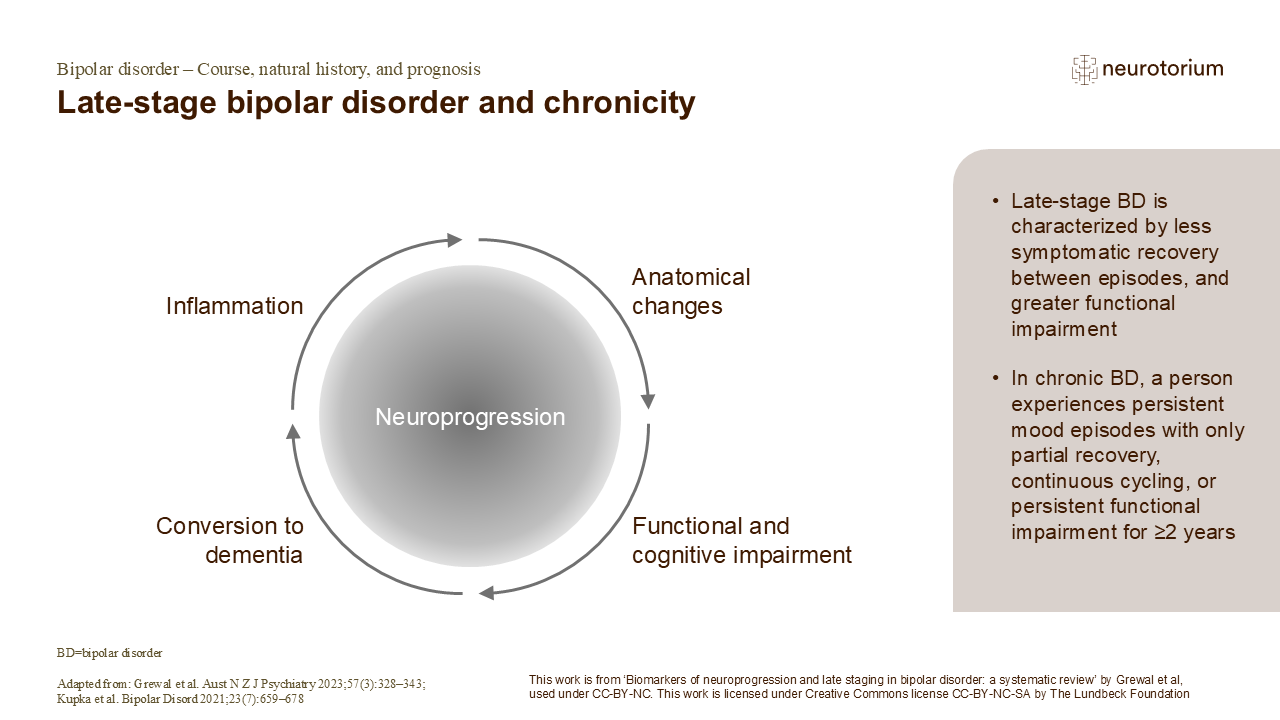
Late-stage bipolar disorder is different from bipolar disorder with a late onset, or of a long duration.2 In late-stage bipolar disorder, the patient experiences less symptomatic recovery, and greater impairment of function.2 Patients in late-stage bipolar disorder have a poorer prognosis than those in earlier stages, and experience a greater impairment in functioning and worse quality of life.2
References:
1. Grewal S, McKinlay S, Kapczinski F, et al. Biomarkers of neuroprogression and late staging in bipolar disorder: a systematic review. Aust N Z J Psychiatry 2023; 57 (3): 328–343.
2. Kupka R, Duffy A, Scott J, et al. Consensus on nomenclature for clinical staging models in bipolar disorder: a narrative review from the International Society for Bipolar Disorders (ISBD) Staging Task Force. Bipolar Disord 2021; 23 (7): 659–678.