

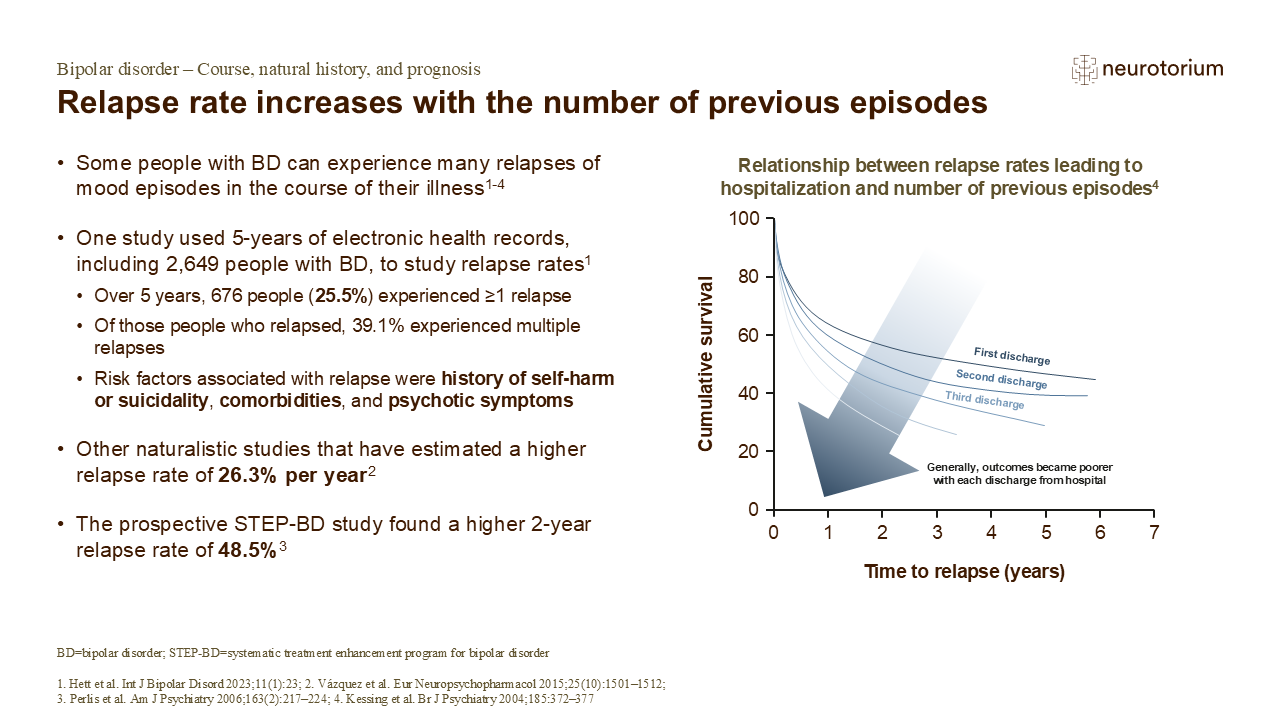
Bipolar disorder is characterized by mood episodes that affect a person’s functioning and reduce their quality of life.5 Long-term data suggest that relapses in the course of bipolar disorder are common for a subset of patients, and are more often depressive episodes than manic episodes.1,5 These depressive episodes are burdensome for the person with bipolar disorder and their family, and to wider society as direct and indirect costs.5
References:
1. Hett D, Morales-Muñoz I, Durdurak BB, et al. Rates and associations of relapse over 5 years of 2649 people with bipolar disorder: a retrospective UK cohort study. Int J Bipolar Disord 2023; 11 (1): 23.
2. Vázquez GH, Holtzman JN, Lolich M, et al. Recurrence rates in bipolar disorder: systematic comparison of long-term prospective, naturalistic studies versus randomized controlled trials. Eur Neuropsychopharmacol 2015; 25 (10): 1501–1512.
3. Perlis RH, Ostacher MJ, Patel JK, et al. Predictors of recurrence in bipolar disorder: primary outcomes from the Systematic Treatment Enhancement Program for Bipolar Disorder (STEP-BD). Am J Psychiatry 2006; 163 (2): 217–224.
4. Kessing LV, Hansen MG, Andersen PK. Course of illness in depressive and bipolar disorders. Naturalistic study, 1994–1999. Br J Psychiatry 2004; 185: 372–377.
5. Miller S, Dell’Osso B, Ketter TA. The prevalence and burden of bipolar depression. J Affect Disord 2014; 169 (Suppl 1): S3–11.