

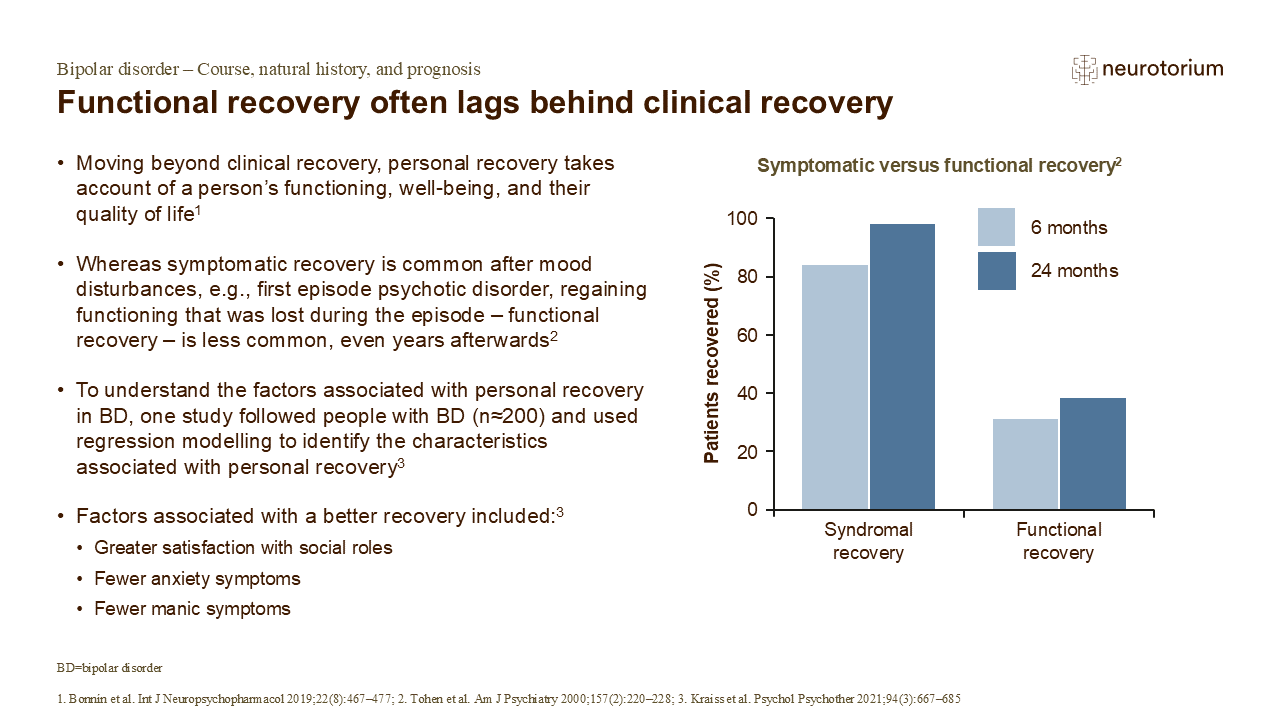
Over the course of the past forty-or-so years, and accelerating over the past decade, there has been an attempt to move beyond definitions of clinical recovery to personalized ideas of recovery that try to account for functioning.1,4 Such definitions have typically centred around personal recovery, social functioning, and occupational functioning.4 This trend towards personalized recovery in healthcare has been welcomed, although more research is needed to understand and predict personal recovery in bipolar disorder.4
References:
1. Bonnín CDM, Reinares M, Martínez-Arán A, et al. Improving functioning, quality of life, and well-being in patients with bipolar disorder. Int J Neuropsychopharmacol 2019; 22 (8): 467–477.
2. Tohen M, Hennen J, Zarate CM Jr, et al. Two-year syndromal and functional recovery in 219 cases of first-episode major affective disorder with psychotic features. Am J Psychiatry 2000; 157 (2): 220–228.
3. Kraiss JT, Ten Klooster PM, Frye E, et al. Exploring factors associated with personal recovery in bipolar disorder. Psychol Psychother 2021; 94 (3): 667–685.
4. Mezes B, Lobban F, Costain D, et al. Recovery beyond clinical improvement – recovery outcomes measured for people with bipolar disorder between 1980 and 2020. J Affect Disord 2022; 309: 375–392.