

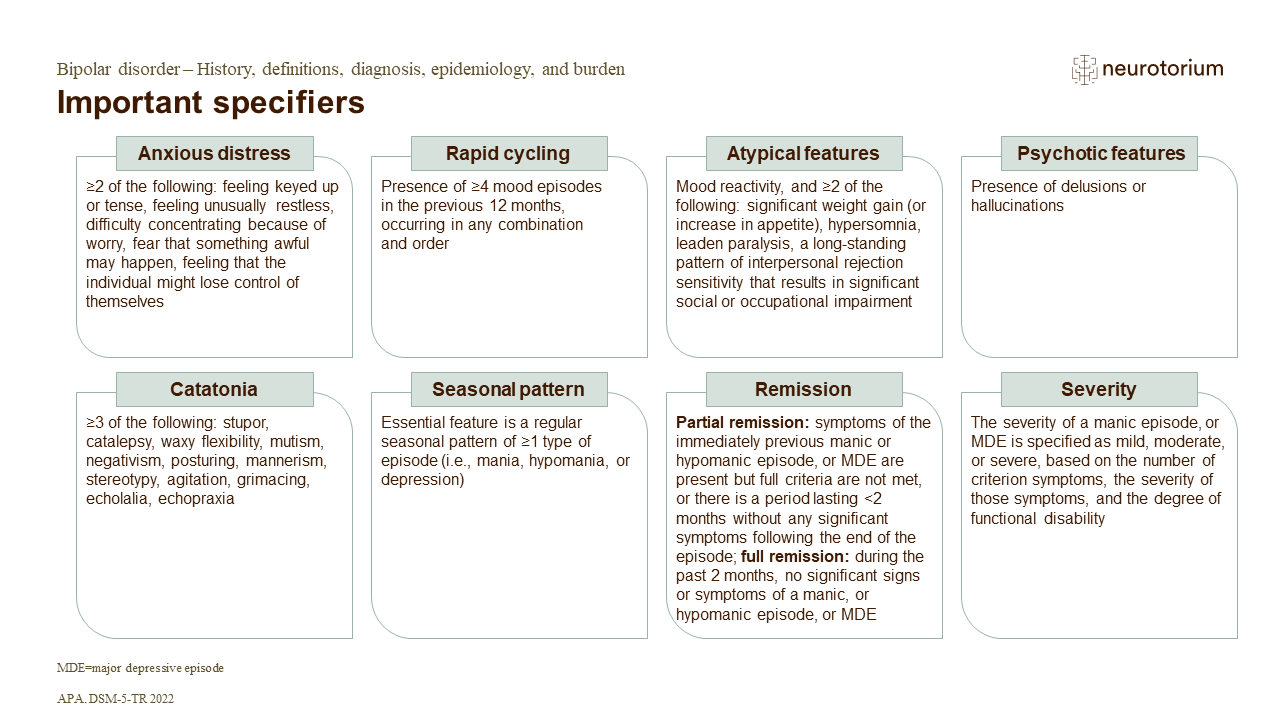
The time at which symptoms occur, and their duration, may determine whether a specifier is applied in the bipolar diagnosis.1
- Anxious distress: symptoms must be present during the majority of days of the current manic, hypomanic, or major depressive episode (MDE) in bipolar I disorder (or the most recent episode if bipolar I disorder is in partial or full remission.1 In bipolar II disorder, symptoms must be present during the majority of days of the current hypomanic or MDE (or the most recent episode if bipolar II disorder is in partial or full remission.1 In cyclothymic disorder, symptoms must be present during the majority of symptomatic days.1
- Rapid cycling: episodes must meet the criteria for manic, hypomanic, or MDE in bipolar I disorder, or meet the criteria for hypomanic or MDE in bipolar II episode.1
- Atypical features: features must predominate during the majority of days of the current MDE (or the most recent MDE if bipolar I or bipolar II disorder is currently in partial or full remission).1 For a diagnosis of atypical features, criteria must not be met for ‘with melancholic features’ or ‘with catatonia’ within the same episode.1
- Psychotic features: symptoms can be present at any time in current manic or MDE in bipolar I disorder (or the most recent manic or major depressive episode if bipolar I disorder is currently in partial or full remission) or in the current MDE in bipolar II disorder (or most recent MDE if bipolar II disorder is currently in partial or full remission).1 If psychotic features are present, it should be specified whether they are mood-congruent or mood-incongruent.1
- Catatonia: specifier may be applied to the current manic or MDE in bipolar I disorder (or the most recent manic or major depressive episode if bipolar I disorder is currently in partial or full remission) or the current MDE in bipolar II (or the most recent MDE if bipolar II disorder is currently in partial or full remission), if features are present during most of the episode.1
- Seasonal pattern: may be applied to the lifetime pattern of mood disorders.1