

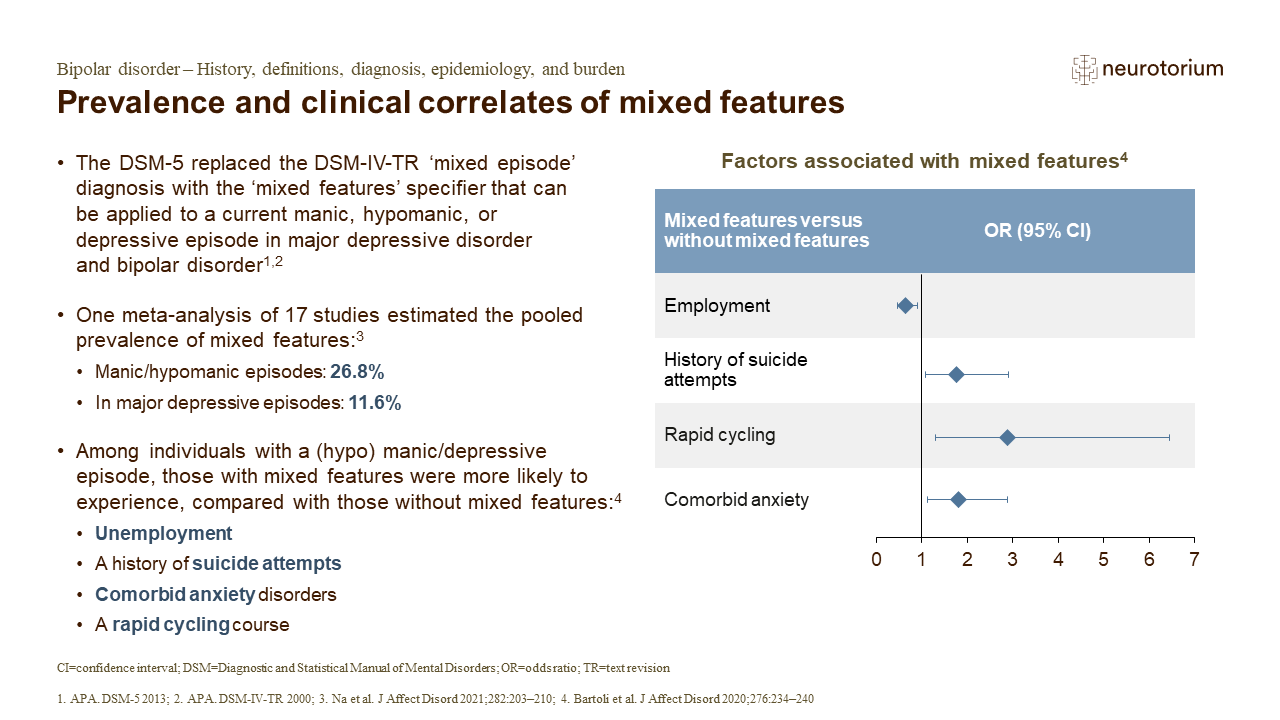
In a systematic review and meta-analysis of sociodemographic and clinical features associated with mixed features in bipolar disorder, subgroup analysis based on the index episode found employment to be the only variable associated with mixed features in patients with bipolar depression.4 Conversely, several variables, including not having a family history of bipolar disorder, and experiencing less severe manic symptoms (compared with patients with pure mania) were associated with mixed features in patients with bipolar mania.4
The DSM-5 ‘mixed features’ specifier may have a substantial impact on the epidemiology, diagnosis, and treatment of mood disorders.5 Patients with mixed features may have different treatment needs, disease course and prognosis, than those without mixed features.6
References:
1. American Psychiatric Association (APA). Diagnostic and Statistical Manual of Mental Disorders. Fifth edition, text revision. Washington DC: APA; 2022.
2. American Psychiatric Association (APA). Diagnostic and Statistical Manual of Mental Disorders. Fourth edition, text revision. Washington DC: APA; 2000.
3. Na KS, Kang JM, Cho SE. Prevalence of DSM-5 mixed features: a meta-analysis and systematic review. J Affect Disord 2021; 282: 203–210.
4. Bartoli F, Crocamo C, Carrà G. Clinical correlates of DSM-5 mixed features in bipolar disorder: a meta-analysis. J Affect Disord 2020; 276: 234–240.
5. Vieta E, Valentí M. Mixed states in DSM-5: implications for clinical care, education, and research. J Affect Disord 2013; 148 (1): 28–36.
6. Rosenblat JD, McIntyre RS. Treatment of mixed features in bipolar disorder. CNS Spectr 2017; 22 (2): 141–146.