

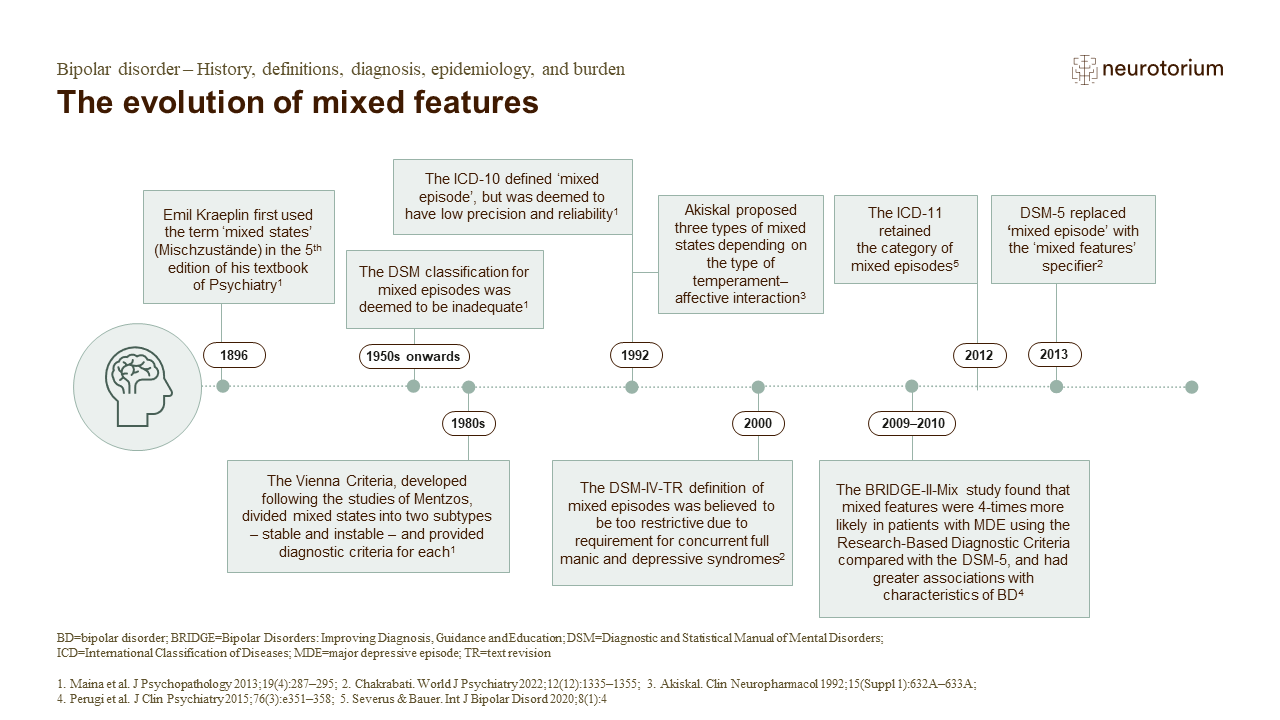
Following the introduction of the ‘mixed features’ specifier in the DSM-5, initial evidence showed that mixed presentations were much more common using the DSM-5 mixed features specifier, compared with the previous DSM-IV-TR mixed episode criteria.2 However, some believe that the DSM-5 excludes symptoms that may be central to the presentation of mixed states, which could result in some individuals with mixed depression being missed by the DSM-5 criteria.2 Due to these controversies, it was recommended that the ICD-11 retain the mixed episode category, rather than adopt the same approach as the DSM-5.6,7 Retaining this category in the ICD-11 may allow further research of its usefulness (e.g., treatment requirements for patients with mixed episodes).2
References:
1. Maina G, Bertetto N, Boccolini D, et al. The concept of mixed state in bipolar disorder: from Kraepelin to DSM-5. J Psychopathology 2013; 19 (4): 287–295.
2. Chakrabarti S. Bipolar disorder in the International Classification of Diseases-Eleventh version: a review of the changes, their basis, and usefulness. World J Psychiatry 2022; 12 (12): 1335–1355.
3. Akiskal HS. The distinctive mixed states of bipolar I, II and III. Clin Neuropharmacol 1992; 15 (Suppl 1): 632A–633A.
4. Perugi G, Angst J, Azorin JM, et al; BRIDGE-II-Mix study group. Mixed features in patients with a major depressive episode: the BRIDGE-II-MIX study. J Clin Psychiatry 2015; 76 (3): e351–358.
5. Severus E, Bauer M. Diagnosing bipolar disorders: ICD-11 and beyond. Int J Bipolar Disord 2020; 8 (1): 4.
6. Østergaard SD, Rothschild AJ, Bertelsen A, Mors O. Rethinking the classification of mixed affective episodes in ICD-11. J Affect Disord 2012; 138 (1–2): 170–172.
7. Malhi GS, Porter RJ. ICD-11 features of a mixed mood state: bold or simply old? Aust N Z J Psychiatry 2016; 50 (10): 1016–1017.