

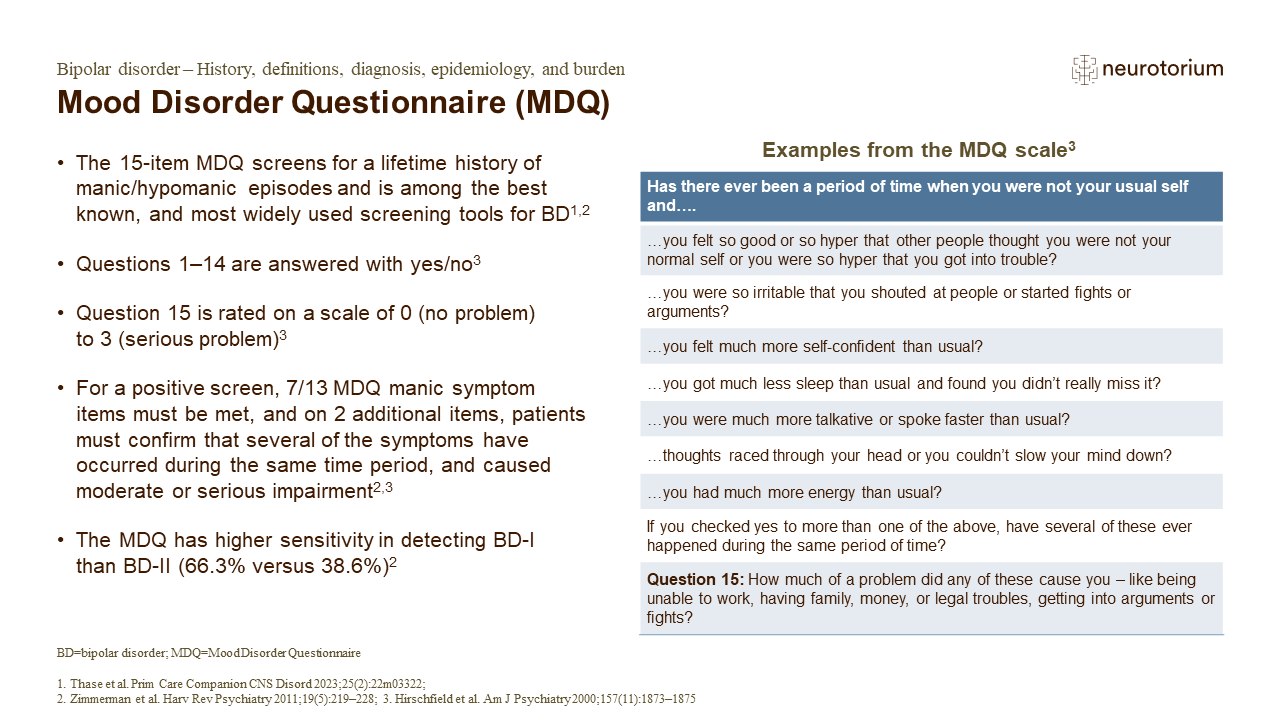
Previous research using the Mood Disorder Questionnaire (MDQ) led to the development of two subscales – the positive activation and negative activation subscales.4,5 The positive activation subscale (items 3, 4, 8, 9) involves increased energy/activity, grandiosity, and decreased need for sleep, and is specific to bipolar disorder.5 The negative activation subscale (items 1, 2, 6, 7, 12, 13), which is more broadly related to emotion dysregulation and transdiagnostic personality traits, involves irritability, racing thoughts, levels of negative affectivity, and distractibility.5 In a meta-analysis of the MDQ’s performance in detecting bipolar disorder, the questionnaire was found to have a sensitivity of 61.3%, specificity of 87.5%, and a positive predictive value of 58.0%.2 However, the MDQ has been criticised for having a high rate of false positives.6
References:
1. Thase ME, Stahl SM, McIntyre RS, et al. Screening for bipolar I disorder and the Rapid Mood Screener: results of a nationwide health care provider survey. Prim Care Companion CNS Disord 2023; 25 (2): 22m03322.
2. Zimmerman M, Galione JN. Screening for bipolar disorder with the Mood Disorders Questionnaire: a review. Harv Rev Psychiatry 2011; 19 (5): 219–228.
3. Hirschfeld RMA, Williams JBW, Spitzer RL, et al. Development and validation of a screening instrument for bipolar spectrum disorder: the Mood Disorder Questionnaire. Am J Psychiatry 2000; 157 (11): 1873–1875.
4. Paterniti S, Bisserbe JC. Factors associated with false positives in MDQ screening for bipolar disorder: insight into the construct validity of the scale. J Affect Disord 2018; 238: 79–86.
5. NovoPsych. Mood Disorder Questionnaire (MDQ). Available at: https://novopsych.com.au/assessments/diagnosis/mood-disorder-questionnaire-mdq/. Accessed 25 January 2024.
6. Carta MG, Angst J. Screening for bipolar disorders: a public health issue. J Affect Disord 2016; 205: 139–143.