

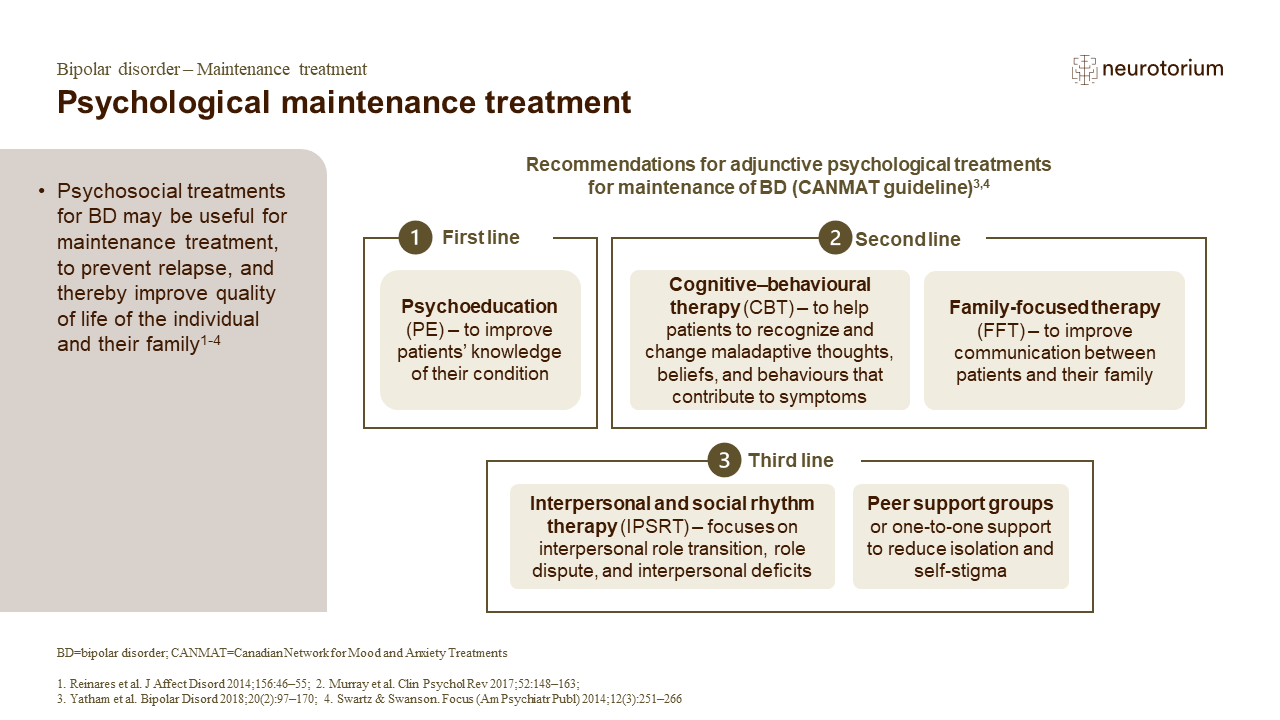
On average, adjunctive psychosocial treatments may reduce recurrence rates during maintenance therapy by approximately 15%.3 Below is a summary of some of the psychosocial treatments available for bipolar disorder:3,4
- Psychoeducation (PE): a key goal of psychoeducation is to create personalized coping strategies to prevent relapse.
- Cognitive–behavioural therapy (CBT): typically administered as 20 sessions over 6 months. Although the use of CBT is supported by several manuals, evidence of its efficacy in BD has been mixed.
- Family-focused therapy (FFT): typically delivered to the patient and family in 21 sessions over 9 months. FFT focuses on communication styles between patients and their families or partners, in an attempt to improve relationship functioning.
- Interpersonal and social rhythm therapy (IPSRT): expands on the IPT focus on grief, the role of self, and interpersonal deficits by including regulation of social and sleep rhythms, specifically targeted to bipolar disorder.
- Peer support: peer groups or one-to-one support may reduce self-stigma and isolation in bipolar disorder, and can also help improve engagement with treatment.
Other psychosocial therapies with varying degrees of less strong evidence include cognitive and functional remediation, dialectical behavioural therapy (DBT), family caregiver interventions, mindfulness based cognitive therapy (MBCT), and online interventions.3
References:
1. Reinares M, Sánchez-Moreno J, Fountoulakis KN. Psychosocial interventions in bipolar disorder: what, for whom, and when. J Affect Disord 2014; 156: 46–55.
2. Murray G, Leitan ND, Thomas N, et al. Towards recovery- oriented psychosocial interventions for bipolar disorder: quality of life outcomes, stage-sensitive treatments, and mindfulness mechanisms. Clin Psychol Rev 2017; 52: 148–163.
3. Yatham LN, Kennedy SH, Parikh SV, et al. Canadian Network for Mood and Anxiety Treatments (CANMAT) and International Society for Bipolar Disorders (ISBD) 2018 guidelines for the management of patients with bipolar disorder. Bipolar Disord 2018; 20 (2): 97–170.
4. Swartz HA, Swanson J. Psychotherapy for bipolar disorder in adults: a review of the evidence. Focus (Am Psychiatr Publ) 2014; 12 (3): 251–266.