

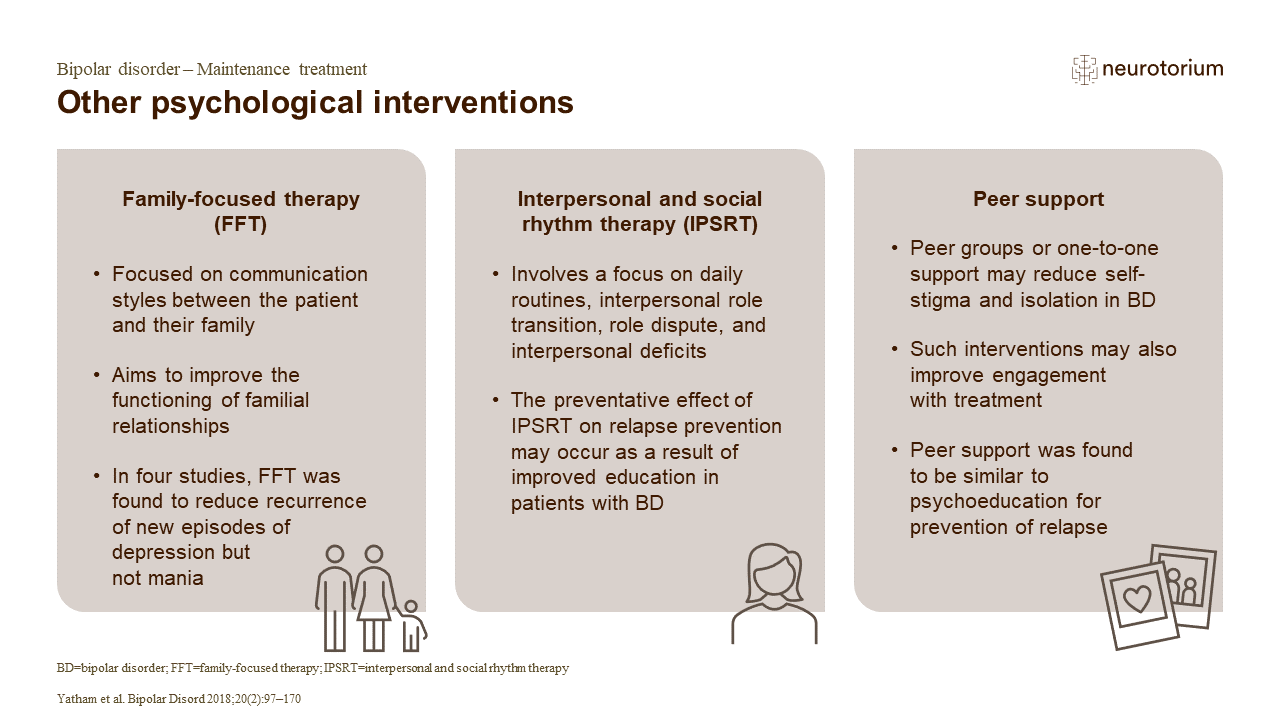
In the Canadian Network for Mood and Anxiety Treatments (CANMAT) guidelines, family-focused therapy (FFT) is recommended as adjunctive second-line treatment for acute bipolar depression (level 2) and for maintenance treatment of bipolar disorder (level 2).1 Interpersonal and social rhythm therapy (IPSRT) is recommended as an adjunctive third-line treatment for acute bipolar depression and for maintenance of bipolar disorder, based on limited level 2 evidence in each phase.1 Due to a lack of evidence, there are currently no recommendations for FFT or IPSRT for mania, in the CANMAT guidelines.1 Peer support interventions are recommended as third-line treatment (level 2) as adjunctive maintenance therapy in the CANMAT guidelines.1 The National Institute for Health and Care Excellence (NICE) guidelines recommend that for maintenance treatment, family intervention should be offered to patients with bipolar disorder living, or in close contact, with their family.2
A network meta-analysis of 39 randomized controlled trials of pharmacotherapy plus manualized psychotherapy found that regulating daily rhythms was amongst the most beneficial interventions for reducing the severity of depression and improving stabilization of manic symptoms, whilst individual therapy format was found to be amongst the least beneficial format of psychotherapy treatment.3
References:
1. Yatham LN, Kennedy SH, Parikh SV, et al. Canadian Network for Mood and Anxiety Treatments (CANMAT) and International Society for Bipolar Disorders (ISBD) 2018 guidelines for the management of patients with bipolar disorder. Bipolar Disord 2018; 20 (2): 97–170.
2. National Institute for Health and Care Excellence. Bipolar disorder: assessment and management. Clinical guideline. 21 December 2023. Available at: www.nice.org.uk/guidance/cg185. Accessed 5 March 2024.
3. Miklowitz DJ, Efthimiou O, Furukawa TA, et al. Adjunctive psychotherapy for bipolar disorder: a systematic review and component network meta-analysis. JAMA Psychiatry 2021; 78 (2): 141–150.