

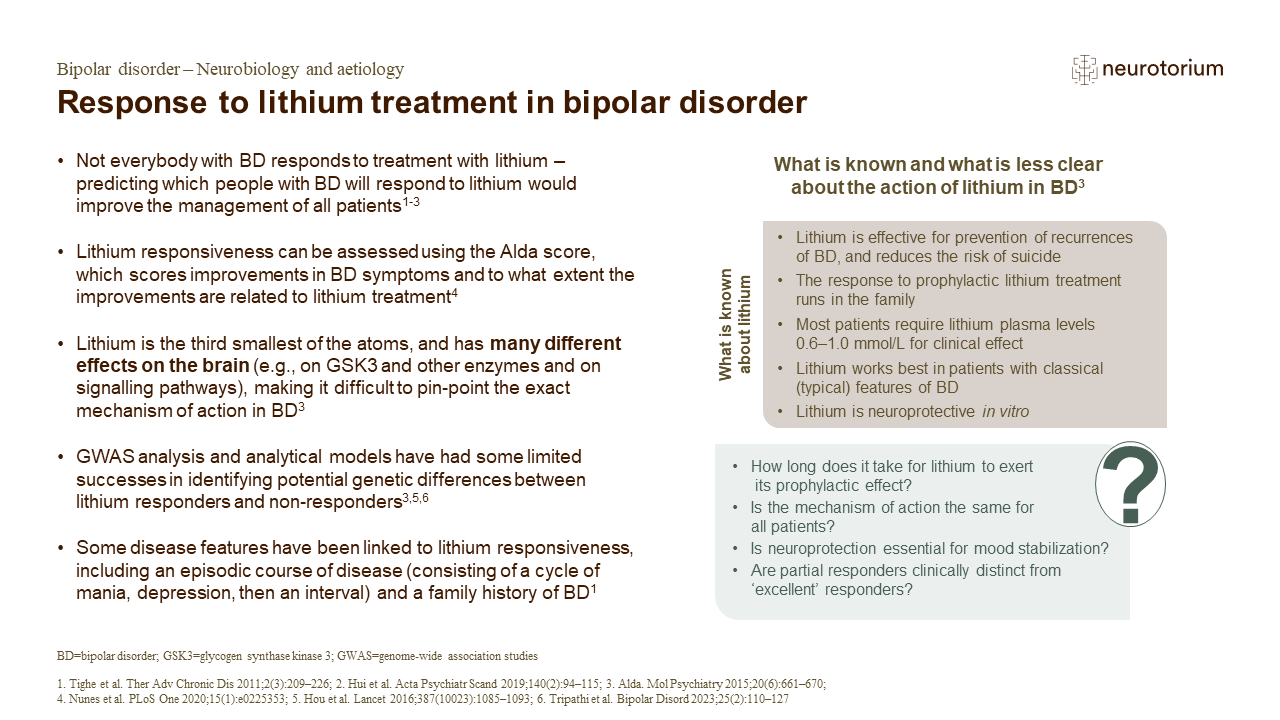
Whilst lithium constitutes the standard treatment for bipolar disorder, its mechanism of action as a mood stabilizer is not fully understood, although research over the years has pointed to the importance of cellular signalling in its mode of action (including glycogen synthase kinase 3 (GSK3) pathways, and modulation of inositol monophosphatase).3 Much research has been devoted to understanding why some people with bipolar disorder respond to lithium whilst others do not.3 Some of the hypothesis in this area comes from animal models and postmortem analysis of brain tissue which, as models of disease, only partially replicate the complex phenomenology of human behaviour.3
References:
1. Tighe SK, Mahon PB, Potash JB. Predictors of lithium response in bipolar disorder. Ther Adv Chronic Dis 2011; 2 (3): 209–226.
2. Hui TP, Kandola A, Shen L, et al. A systematic review and meta-analysis of clinical predictors of lithium response in bipolar disorder. Acta Psychiatr Scand 2019; 140 (2): 94–115.
3. Alda M. Lithium in the treatment of bipolar disorder: pharmacology and pharmacogenetics. Mol Psychiatry 2015; 20 (6): 661–670.
4. Nunes A, Trappenberg T, Alda M; international Consortium on Lithium Genetics (ConLiGen). Asymmetrical reliability of the Alda score favours a dichotomous representation of lithium responsiveness. PLoS One 2020; 15 (1): e0225353.
5. Hou L, Heilbronner U, Degenhardt F, et al. Genetic variants associated with response to lithium treatment in bipolar disorder: a genome-wide association study. Lancet 2016; 387 (10023): 1085–1093.
6. Tripathi U, Mizrahi L, Alda M, et al. Information theory characteristics improve the prediction of lithium response in bipolar disorder patients using a support vector machine classifier. Bipolar Disord 2023; 25 (2): 110–127.