

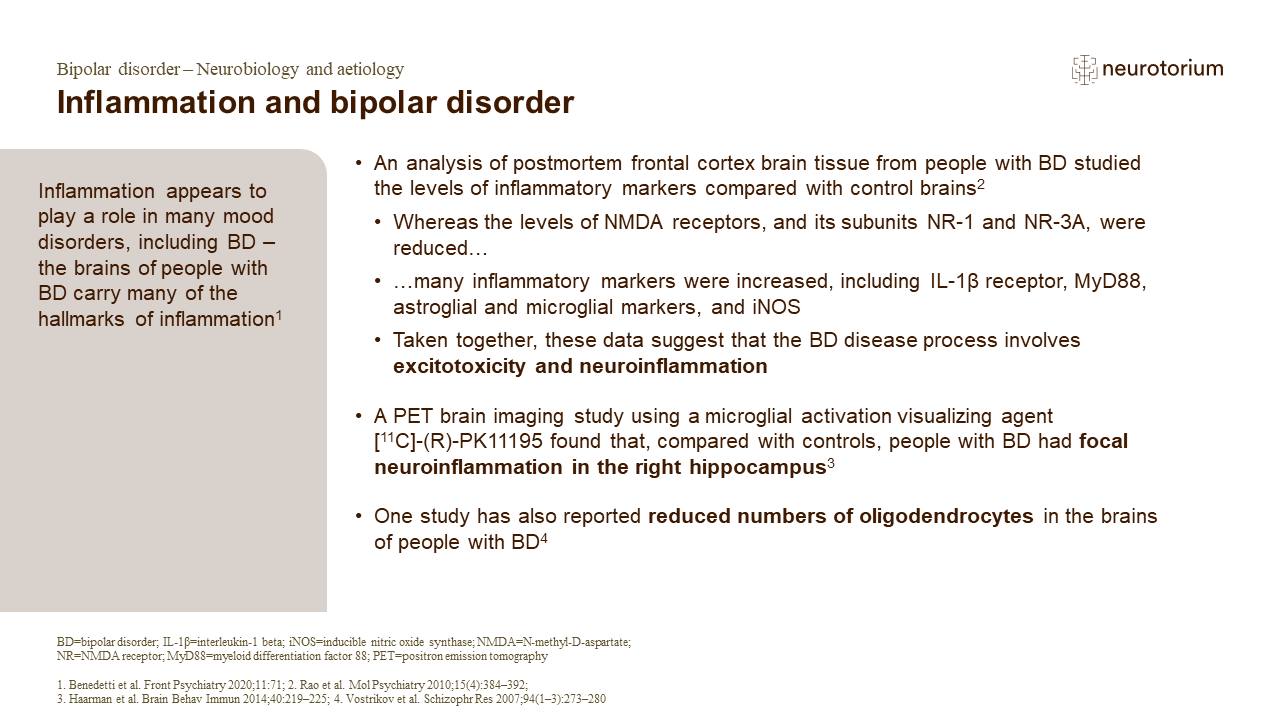
Researchers initially connected the immune system and mood disorders by observing so-called ‘sickness behaviour’ – the idea that acute inflammatory states induced a complex set of behavioural and mood changes, that partly mimic the states of some psychiatric conditions.1 Also, people with mood disorders appear to have a greater risk of autoimmune conditions than the general population.1 This has led people to investigate the possible roles of the immune system and inflammation in the pathology of mood disorders, including bipolar disorder, as outlined on the slide.1
References:
1. Benedetti F, Aggio V, Pratesi ML, et al. Neuroinflammation in bipolar depression. Front Psychiatry 2020; 11: 71.
2. Rao JS, Harry GJ, Rapoport SI, Kim HW. Increased excitotoxicity and neuroinflammatory markers in postmortem frontal cortex from bipolar disorder patients. Mol Psychiatry 2010; 15 (4): 384–392.
3. Haarman BCM, Riemersma-Van der Lek RF, de Groot JC, et al. Neuroinflammation in bipolar disorder – a [(11)C]-(R)-PK11195 positron emission tomography study. Brain Behav Immun 2014; 40: 219–225.
4. Vostrikov VM, Uranova NA, Orlovskaya DD. Deficit of perineuronal oligodendrocytes in the prefrontal cortex in schizophrenia and mood disorders. Schizophr Res 2007; 94 (1–3): 273–280.