

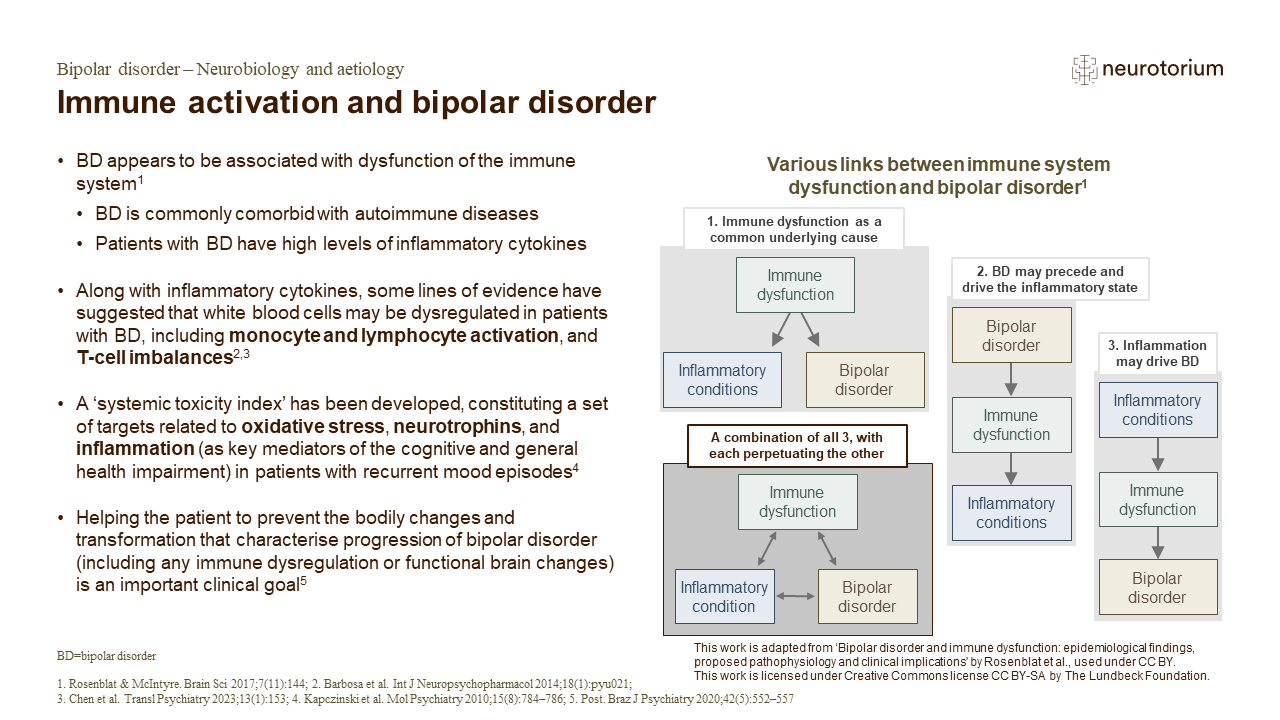
A clue to the connection between bipolar disorder and the immune system and inflammation comes from the observation that people with bipolar disorder appear to have high rates of inflammatory comorbidities.1 However, correlation is not causation. It is possible that bipolar disorder and other inflammatory conditions share common underlying aetiologies, or that bipolar disorder leads to immune dysfunction and inflammation, or that the inflammatory disorders in some way lead to bipolar disorder.1 In reality, the complex relationship observed in the real-world suggest that in part all three of these relationships exist, suggesting a situation where immune activation and dysfunction, inflammation, and bipolar disorder may be perpetuating each other.1
References:
1. Rosenblat JD, McIntyre RS. Bipolar disorder and immune dysfunction: epidemiological findings, proposed pathophysiology and clinical implications. Brain Sci 2017; 7 (11): 144.
2. Barbosa IG, Rocha NP, Assis F, et al. Monocyte and lymphocyte activation in bipolar disorder: a new piece in the puzzle of immune dysfunction in mood disorders. Int J Neuropsychopharmacol 2014; 18 (1): pyu021.
3. Chen Z, Huang Y, Wang B, et al. T cells: an emerging cast of roles in bipolar disorder. Transl Psychiatry 2023; 13 (1): 153.
4. Kapczinski F, Dal-Pizzol F, Teixeira AL, et al. A systemic toxicity index developed to assess peripheral changes in mood episodes. Mol Psychiatry 2010; 15 (8): 784–786.
5. Post RM. How to prevent the malignant progression of bipolar disorder. Braz J Psychiatry 2020; 42 (5): 552–557.