

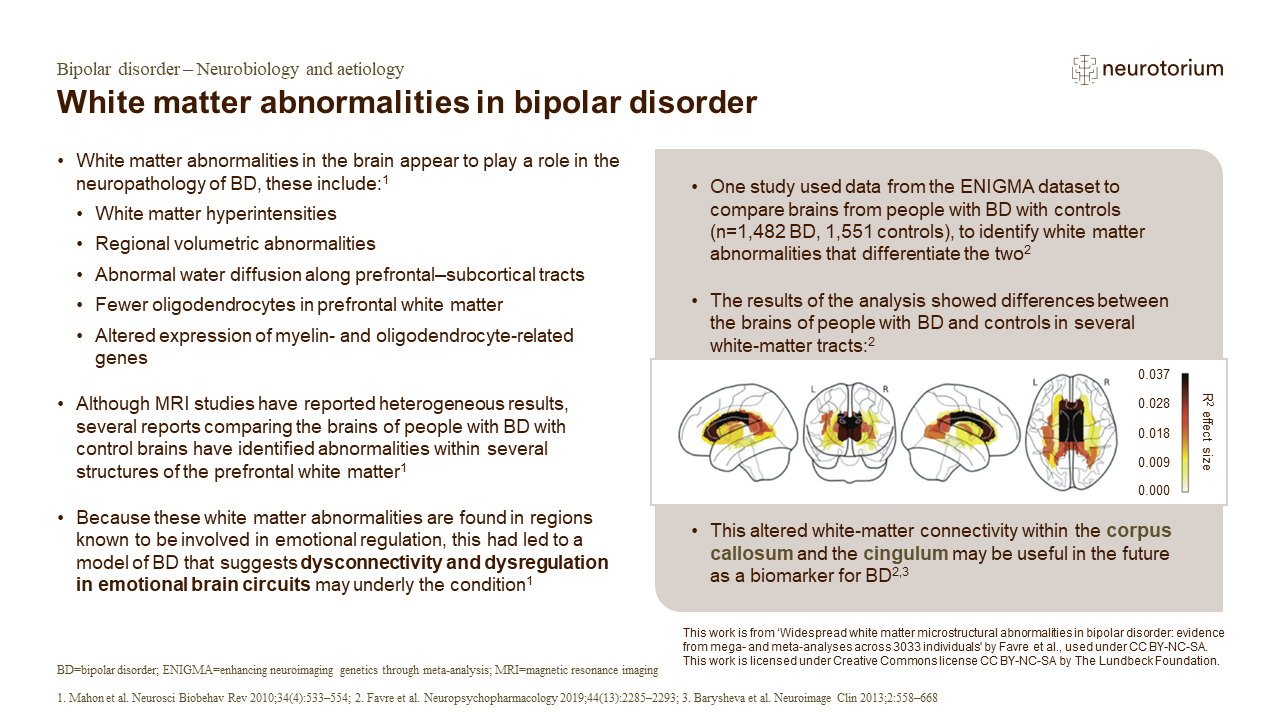
As well as postmortem brain studies, data from computed tomography (CT), positron emission tomography (PET), and magnetic resonance imaging (MRI) studies have shown white matter abnormalities are a characteristic of bipolar disorder.1 However, the clinical significance of these abnormalities is unclear.1 In contrast to grey matter, white matter is responsible for connectivity within the brain; therefore, new imaging techniques that have allowed white matter imaging (e.g., diffusion tensor imaging), allow researchers to build connectivity-based models of bipolar disorder.1
References:
1. Mahon K, Burdick KE, Szeszko PR. A role for white matter abnormalities in the pathophysiology of bipolar disorder. Neurosci Biobehav Rev 2010; 34 (4): 533–554.
2. Favre P, Pauling M, Stout J, et al. ENIGMA Bipolar Disorder Working Group. Widespread white matter microstructural abnormalities in bipolar disorder: evidence from mega- and meta-analyses across 3033 individuals. Neuropsychopharmacology 2019; 44 (13): 2285–2293.
3. Barysheva M, Jahanshad N, Foland-Ross L, et al. White matter microstructural abnormalities in bipolar disorder: a whole brain diffusion tensor imaging study. Neuroimage Clin 2013; 2: 558–668.