

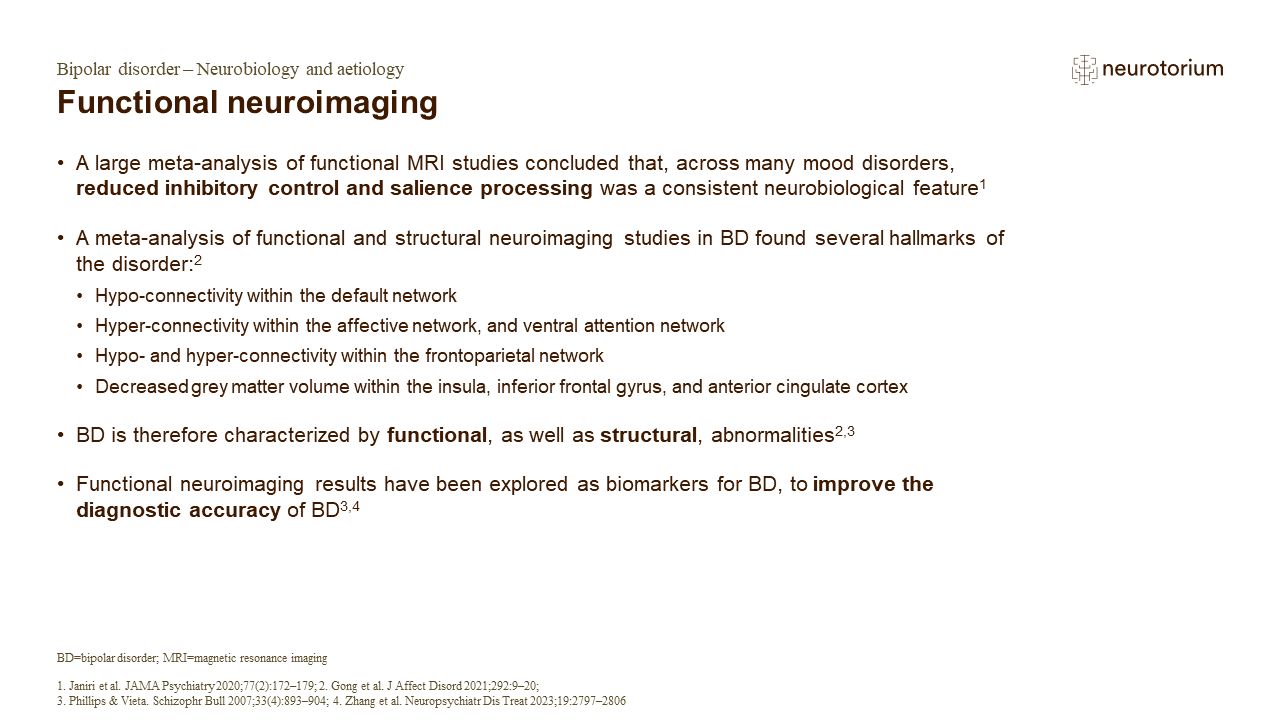
Since the publication of the fifth edition of the Diagnostic and Statistical Manual of Mental Disorders (DSM-5), there has been an awareness of the need to translate the increasing depth of mechanistic and neurobiological knowledge of psychiatric disease back into the classification systems used to diagnose patients.3 Understanding bipolar disorder using techniques such as functional and structural neuroimaging, and translating this understanding into biomarkers, may allow such accuracy of diagnosis in the future.3
References:
1. Janiri D, Moser DA, Doucet GE, et al. Shared neural phenotypes for mood and anxiety disorders a meta-analysis of 226 task-related functional imaging studies. JAMA Psychiatry 2020; 77 (2): 172–179.
2. Gong J, Wang J, Chen P, et al. Large-scale network abnormality in bipolar disorder: a multimodal meta-analysis of resting-state functional and structural magnetic resonance imaging studies. J Affect Disord 2021; 292: 9–20.
3. Phillips ML, Vieta E. Identifying functional neuroimaging biomarkers of bipolar disorder: toward DSM-V. Schizophr Bull 2007; 33 (4): 893–904.
4. Zhang H, Chen J, Fang Y. Functional alterations in patients with bipolar disorder and their unaffected first-degree relatives: insight from genetic, epidemiological, and neuroimaging data. Neuropsychiatr Dis Treat 2023; 19: 2797–2806.