

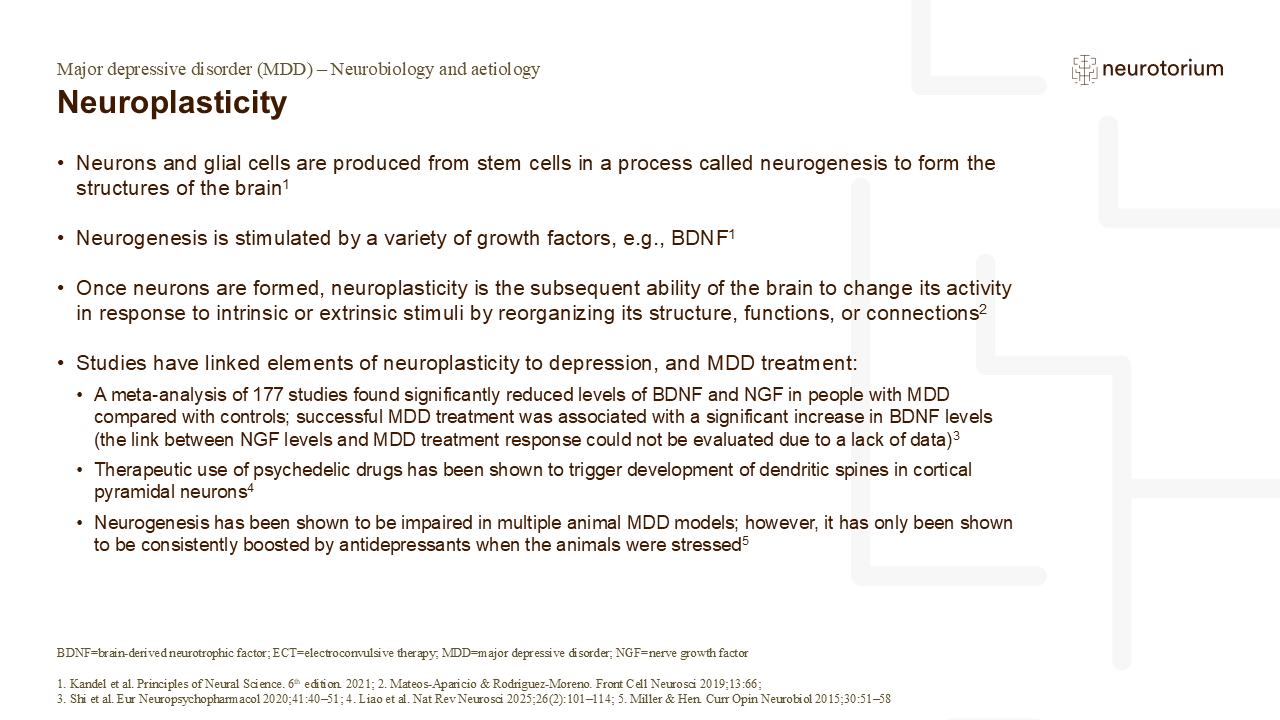
Animal studies evaluating whether neurogenesis is crucial for antidepressant efficacy have produced mixed results: rodent models suggest that neurogenesis is required for antidepressant efficacy in stressed mice, with some antidepressant and anxiolytic effects observed in non-stressed mice even in the absence of neurogenesis.6 Non-human primate models have shown that the ablation of adult hippocampal neurogenesis by irradiation blocks antidepressant ability to prevent stress-induced anhedonia.6
References:
- Kandel ER, Koester JD, Mack SH, Siegelbaum SA (eds). Principles of Neural Science. 6th edition. © McGraw-Hill, 2021.
- Mateos-Aparicio P, Rodríguez-Moreno A. The impact of studying brain plasticity. Front Cell Neurosci 2019; 13: 66.
- Shi Y, Luan D, Song R, Zhang Z. Value of peripheral neurotrophin levels for the diagnosis of depression and response to treatment: a systematic review and meta-analysis. Eur Neuropsychopharmacol 2020; 41: 40–51.
- Liao C, Dua AN, Wojtasiewicz C, et al. Structural neural plasticity evoked by rapid-acting antidepressant interventions. Nat Rev Neurosci 2025; 26 (2): 101–114.
- Miller BR, Hen R. The current state of the neurogenic theory of depression and anxiety. Curr Opin Neurobiol 2015; 30: 51–58.