

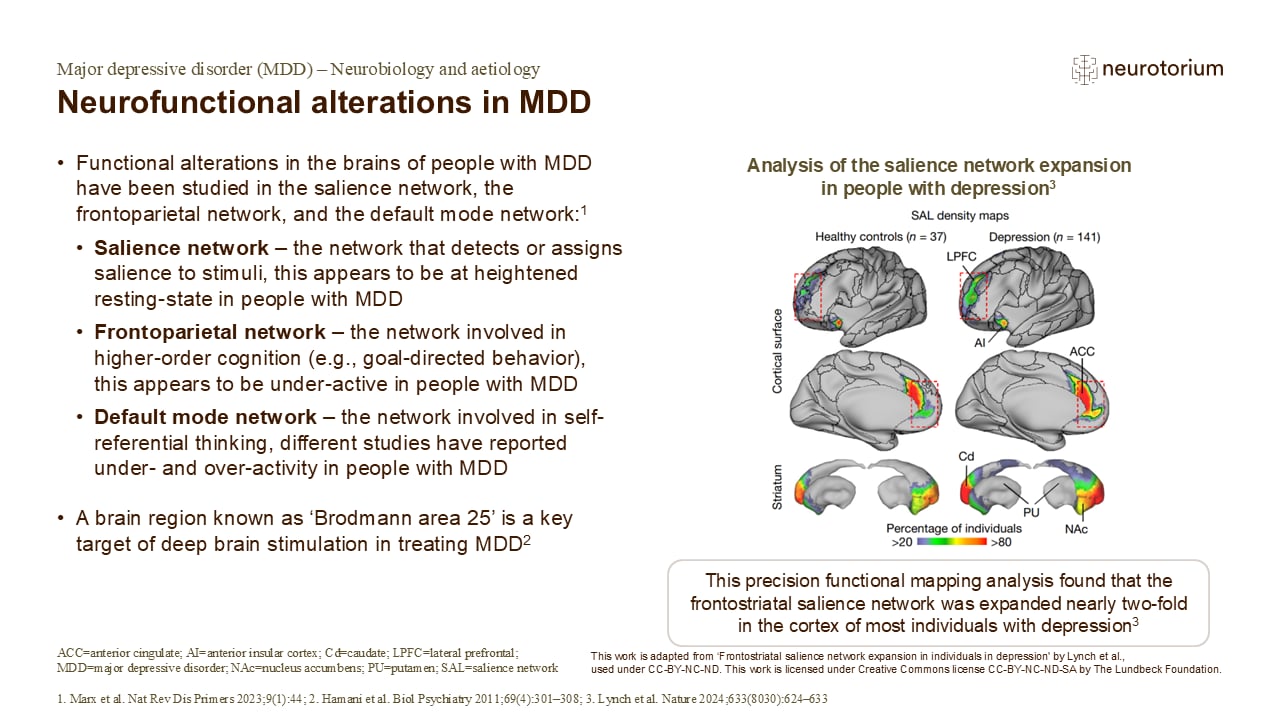
Resting-state functional magnetic resonance imaging suggests that compared with healthy controls, the brains of people with major depressive disorder (MDD) spend significantly longer in states characterized by weak functional connectivity within and between all brain networks; the proportional time spent and temporal stability of this state seems to be significantly associated with MDD severity.4
References:
- Marx W, Penninx BWJH, Solmi M, et al. Major depressive disorder. Nat Rev Dis Primers 2023; 9 (1): 44.
- Hamani C, Mayberg H, Stone S, et al. The subcallosal cingulate gyrus in the context of major depression. Biol Psychiatry 2011; 69 (4): 301–308.
- Lynch CJ, Elbau IG, Ng T, et al. Frontostriatal salience network expansion in individuals in depression. Nature 2024; 633 (8030): 624–633.
- Javaheripour N, Colic L, Opel N, et al. Altered brain dynamic in major depressive disorder: state and trait features. Transl Psychiatr 2023; 13: 261.