

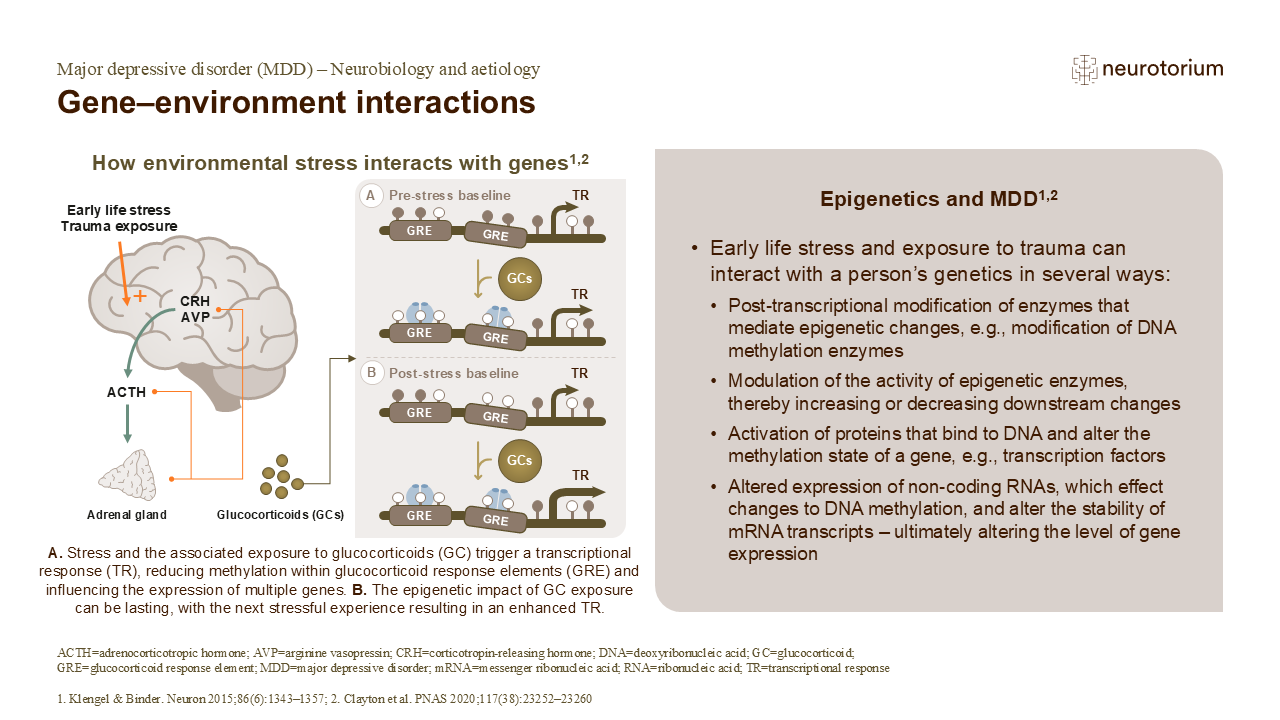
Discrete time-limited pulses of neural gene expression in response to immediate experiences are called the genomic action potential (the gAP).2 The gAP affects the proteins, RNA, and chromatin structure in the cells of the nervous system, thus influencing how the cells will respond to a subsequent activation event, and how they will communicate.2 The gAP plays a key role in responding to stress through recording stressful associations and shaping future responses to similar circumstances.2
An exposure to stress is associated with the stress-driven activation of the hypothalamo-pituitary-adrenal axis and the release of glucocorticoids, which trigger rapid transcriptomic responses through intracellular receptors acting as transcription factors.2 The activation of transcription factors triggers downstream gene regulation starting within 30–60 minutes following the stress exposure, and peaking 3–6 hours afterwards.2 Glucocorticoids elicit graded transcriptional responses depending on timing and place.2 Apart from inducing a stress transcriptome profile, the glucocorticoid receptor activation also induces local epigenetic changes at the glucocorticoid response elements, its DNA binding sites.2 Depending on the developmental timing and genetic factors, these epigenetic changes can be lasting, changing the subsequent stress gAP and resulting in an enhanced transcriptional response to stressful experiences,2 and in changes to the expression of multiple genes involved in the stress response, immune function and metabolism.1
References:
- Klengel T, Binder EB. Epigenetics of stress-related psychiatric disorders and gene × environment interactions. Neuron 2015; 86 (6): 1343–1357.
- Clayton DF, Anreiter I, Aristizabal M, et al. The role of the genome in experience-dependent plasticity: Extending the analogy of the genomic action potential. PNAS 2020; 117 (38): 23252–23260.