

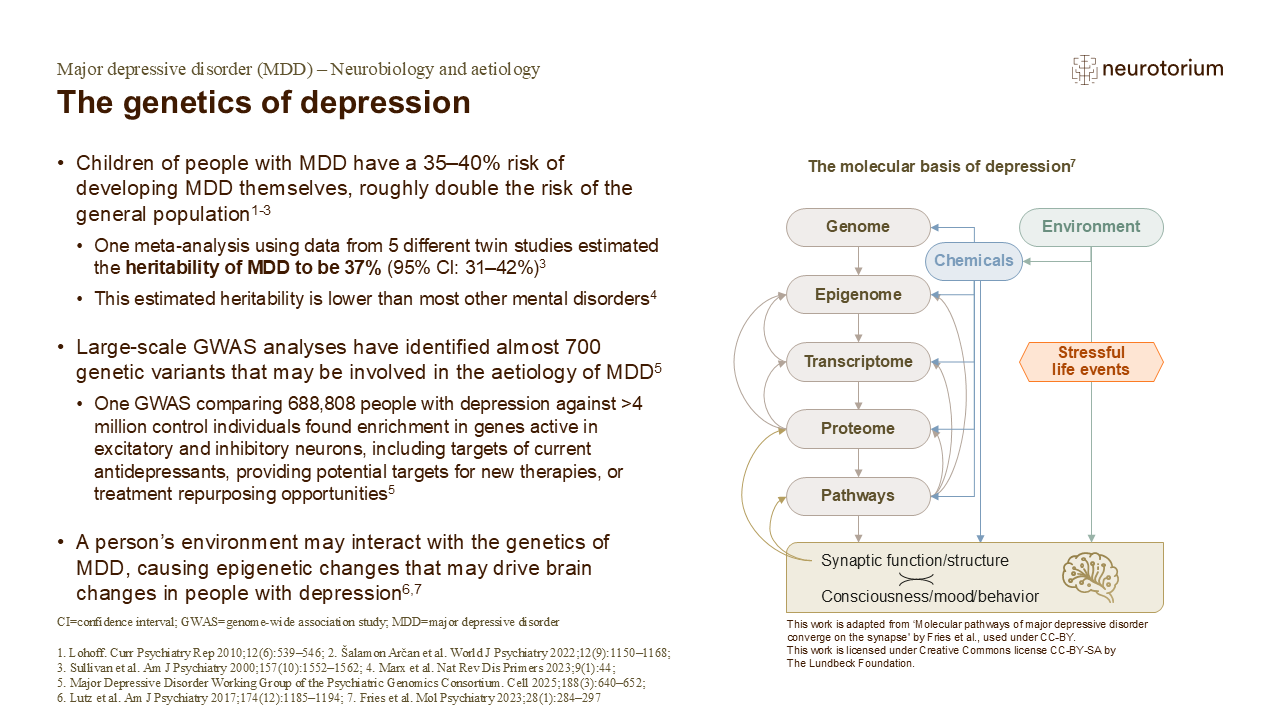
Since 2013, genome-wide association studies (GWAS) have provided significant insight into the mechanisms underlying major depressive disorder (MDD) and its genetic risk factors.5 They have estimated the single nucleotide polymorphism (SNP)-based heritability of MDD to be 8.4% (assuming a lifetime MDD risk of 15%); however, additional GWAS studies across global populations are required to confirm the heritability of MDD in people with diverse (non-European) ancestries, and to identify new drug targets for MDD treatment.5
Environmental factors may significantly impact gene expression in people with MDD through epigenetic mechanisms.6 For example, child abuse is associated with epigenetic reprogramming of oligodendrocytes, with possible lasting adverse effects on cortical myelination in people with MDD who experienced childhood abuse compared with people with MDD who did not.6
References:
- Lohoff FW. Overview of the genetics of major depressive disorder. Curr Psychiatry Rep 2010; 12 (6): 539–546.
- Šalamon Arčan I, Kouter K, Videtič Paska A. Depressive disorder and antidepressants from an epigenetic point of view. World J Psychiatry 2022; 12 (9): 1150–1168.
- Sullivan PF, Neale MC, Kendler KS. Genetic epidemiology of major depression: review and meta-analysis. Am J Psychiatry 2000; 157 (10): 1552–1562.
- Marx W, Penninx BWJH, Solmi M, et al. Major depressive disorder. Nat Rev Dis Primers 2023; 9 (1): 44.
- Major Depressive Disorder Working Group of the Psychiatric Genomics Consortium. Trans-ancestry genome-wide study of depression identifies 697 associations implicating cell types and pharmacotherapies. Cell 2025; 188 (3): 640–652.
- Lutz PE, Tanti A, Gasecka A, et al. Association of a history of child abuse with impaired myelination in the anterior cingulate cortex: Convergent epigenetic, transcriptional, and morphological evidence. Am J Psychiatry 2017; 174 (12): 1185–1194.
- Fries GR, Saldana VA, Finnstein J, Rein T. Molecular pathways of major depressive disorder converge on the synapse. Mol Psychiatry 2023; 28 (1): 284–297.