

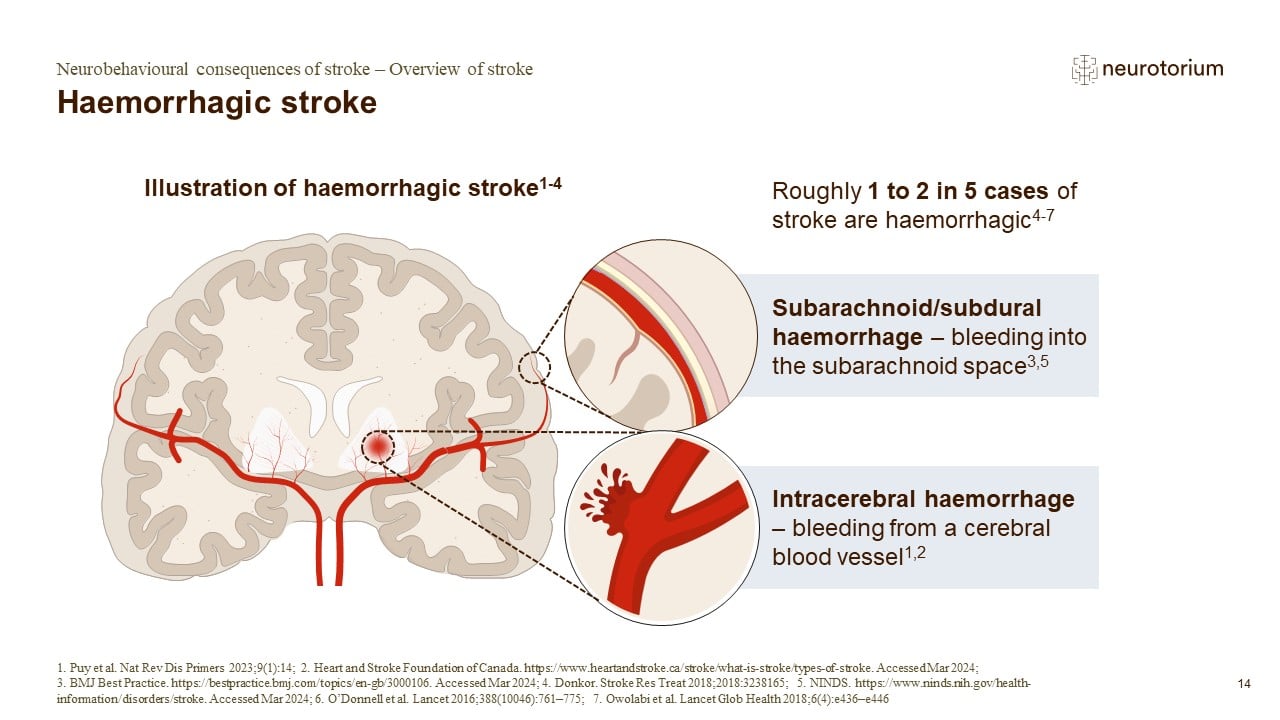
Unlike ischaemic stroke, there are no specific treatments for haemorrhagic stroke, which is most commonly caused by an intracerebral haemorrhage.1 Diagnosis should be performed using computed tomography (CT) head scan, which can confirm the bleeding.3,8 Mortality rates in patients with haemorrhagic stroke/intracerebral haemorrhage are high; only approximately 50% of patients survive for one year after intracerebral haemorrhage.1 A rare cause of haemorrhagic stroke, a subarachnoid haemorrhage (bleeding within the subarachnoid space surrounding the brain) usually causes a severe immediate headache, vomiting, and photophobia.3 Like all forms of stroke, it is a medical emergency.3,8
References:
2. Heart and Stroke Foundation of Canada. Available at: https://www.heartandstroke.ca/stroke/what-is-stroke/types-of-stroke. Accessed March 2024.
3. BMJ Best Practice. Subarachnoid haemorrhage. Available at: https://bestpractice.bmj.com/topics/en-gb/3000106. July 2023. Accessed March 2024.
5. NINDS. Available at: https://www.ninds.nih.gov/health-information/disorders/stroke. Accessed March 2024.
8. BMJ Best Practice. Stroke due to spontaneous intracerebral haemorrhage. Available at: https://bestpractice.bmj.com/topics/en-gb/3000109. April 2023. Accessed March 2024.