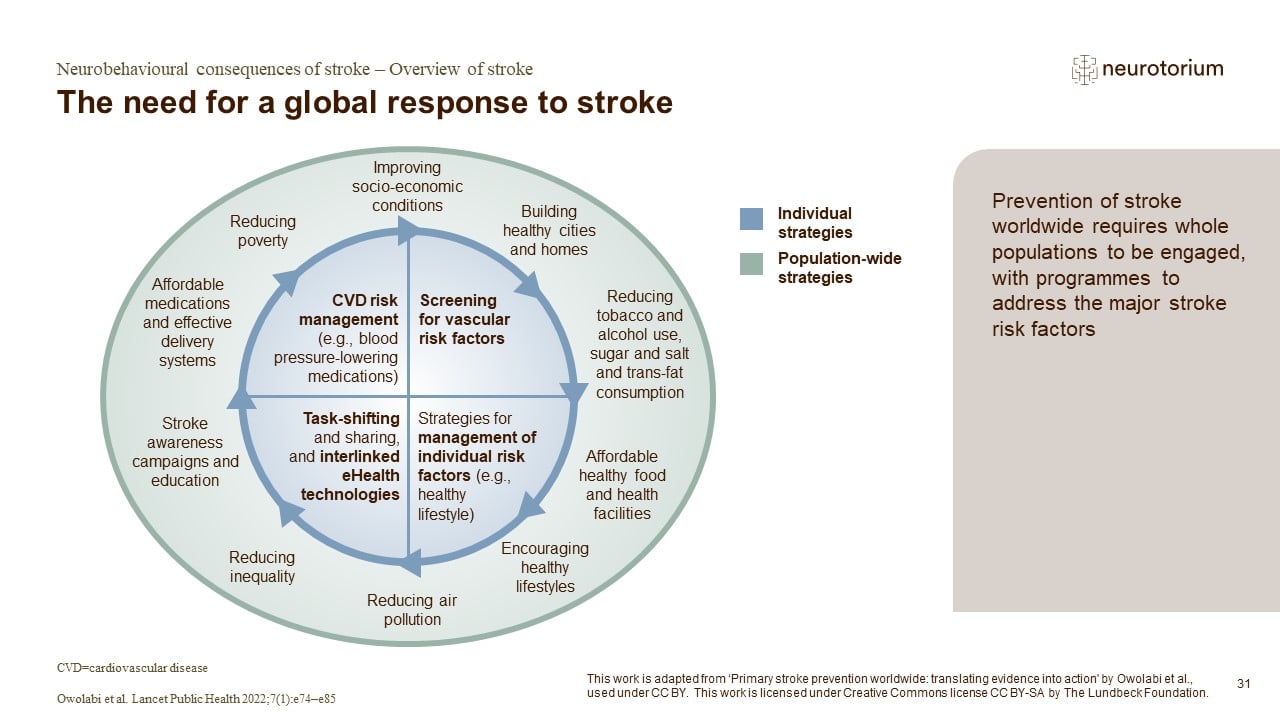
The burden of stroke in Africa is considerable; compared with the developed world, stroke in Africa tends to have a younger age of onset, and greater fatality.2,3 Treating acute stroke in low- and middle-income countries can be particularly challenging, for example deciding how to manage stroke when a computerized tomography (CT) scanner is not available to differentiate between haemorrhagic and ischaemic stroke.3,4 Some have called for greater awareness of low- and middle-income countries when treatment guidelines are developed, including considering how guidelines can be contextualised to different countries.5 The slide shows a set of interventions aimed at government level to help focus the world on preventing stroke.5
References:
1. Owolabi MO, Thrift AG, Mahal A, et al.; Stroke Experts Collaboration Group. Primary stroke prevention worldwide: translating evidence into action. Lancet Public Health 2022; 7 (1): e74–e85.
2. Owolabi MO, Akarolo-Anthony S, Akinyemi R, et al.; Members of the H3Africa Consortium. The burden of stroke in Africa: a glance at the present and a glimpse into the future. Cardiovasc J Afr 2015; 26 (2 Suppl. 1): S27–S38.
3. Johnson W, Onuma O, Owolabi M, Sachdev S. Stroke: a global response is needed. Bull World Health Organ 2016; 94 (9): 634–634A.
4. Berkowitz AL. Managing acute stroke in low-resource settings. Bull World Health Organ 2016; 94 (7): 554–556.
5. Owolabi M, Miranda JJ, Yaria J, Ovbiagele B. Controlling cardiovascular diseases in low and middle income countries by placing proof in pragmatism. BMJ Glob Health 2016; 1 (3): e000105.