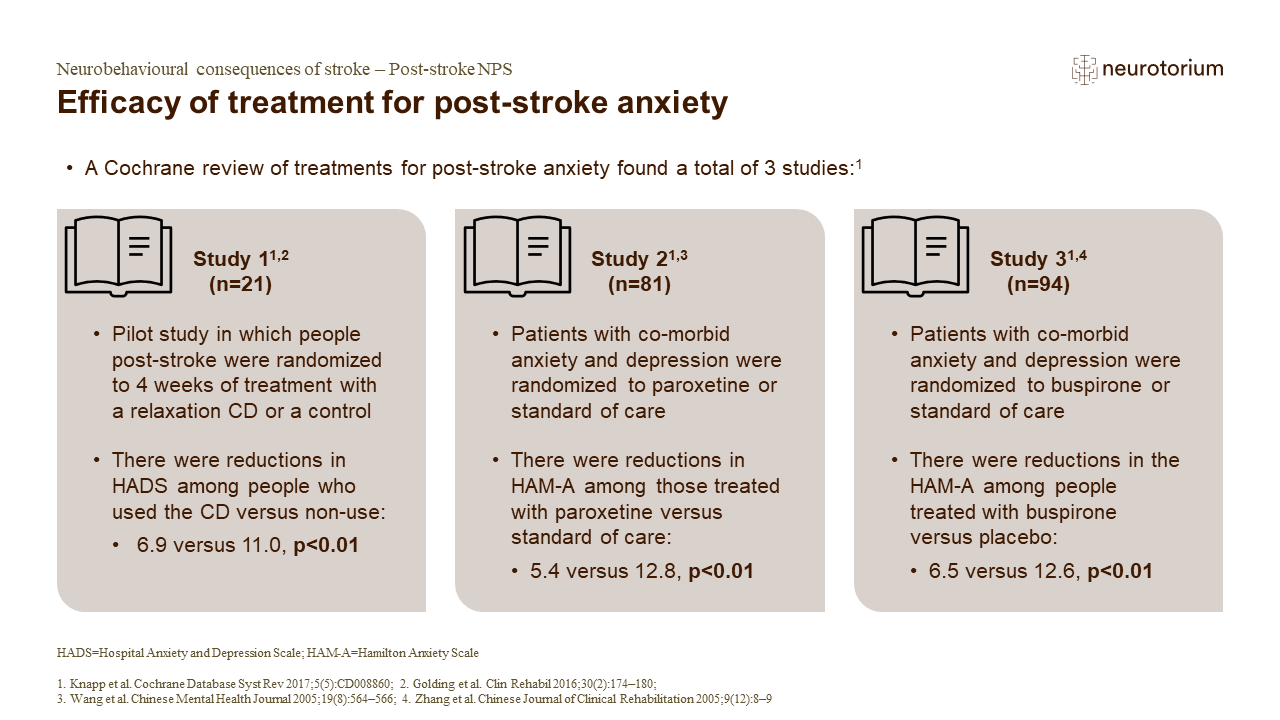
This Cochrane review found a total of three studies of therapies for post-stroke anxiety that met the inclusion criteria, each of which is outlined on the slide, including a total of 196 participants.1 The studies were of low quality, with low numbers of patients and with insufficient reporting to judge the risk of bias.1 The authors emphasise the need for more studies of greater quality to assess how best to treat anxiety in people after a stroke.1
Reference:
1.Knapp P, Campbell Burton CA, Holmes J, et al. Interventions for treating anxiety after stroke. Cochrane Database Syst Rev 2017; 5 (5): CD008860.
2.Golding K, Kneebone I, Fife-Schaw C. Self-help relaxation for post-stroke anxiety: a randomised, controlled pilot study. Clin Rehabil 2016; 30 (2): 174–180.
3.Wang X, Yan H, Xiao CL. A clinical trial of paroxetine and psychotherapy in patients with poststroke depression and anxiety. Chinese Mental Health Journal 2005; 19 (8): 564–566.
4.Zhang YX, Zhang HL, Wang H. Effects of buspirone hydrochloride on post-stroke affective disorder and neural function. Chinese Journal of Clinical Rehabilitation 2005; 9 (12): 8–9.