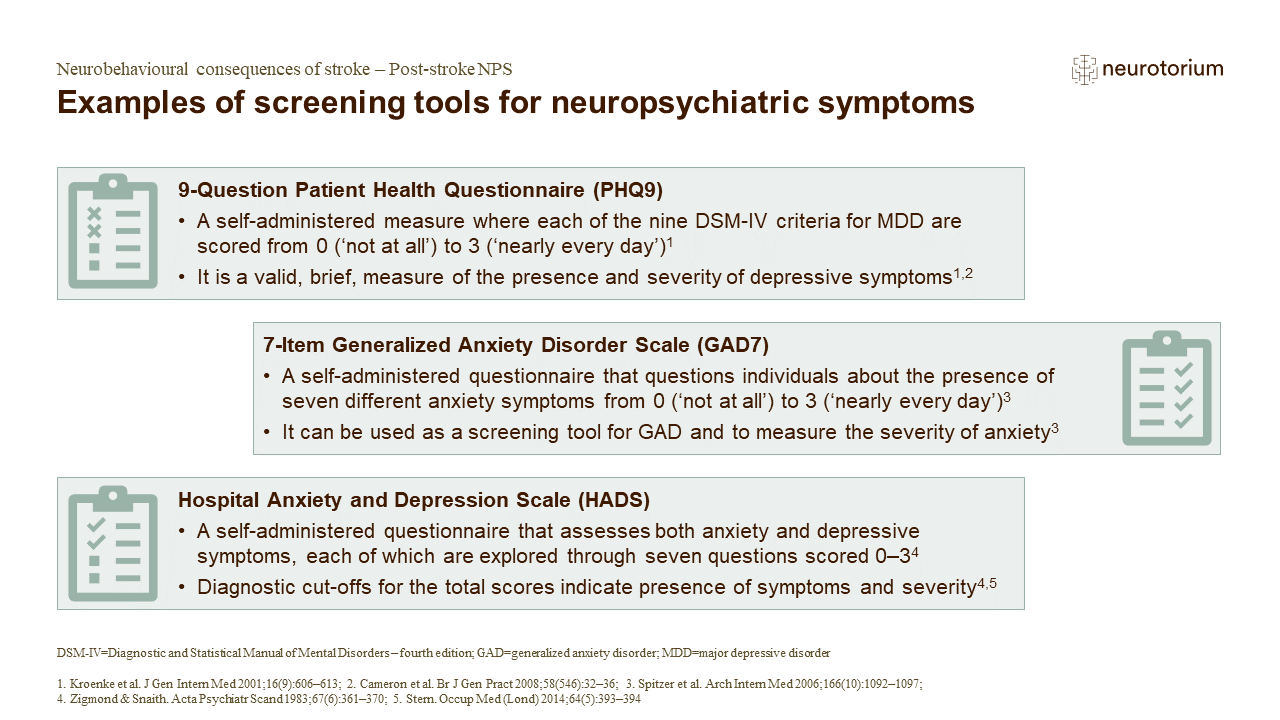
Whilst there are no established screening tools for many of the neuropsychiatric symptoms that can occur after a stroke, there are screening tools which are clinically useful, some of which are introduced on the slide.6 Adapted screening tools for people with varying degrees of aphasia exist, which should be used to screen for neuropsychiatric symptoms in people with aphasia.7
References:
1.Kroenke K, Spitzer RL, Williams JB. The PHQ-9: validity of a brief depression severity measure. J Gen Intern Med 2001; 16 (9): 606–613.
2.Cameron IM, Crawford JR, Lawton K, Reid IC. Psychometric comparison of PHQ-9 and HADS for measuring depression severity in primary care. Br J Gen Pract 2008; 58 (546): 32–36.
3.Spitzer RL, Kroenke K, Williams JB, Löwe B. A brief measure for assessing generalized anxiety disorder: the GAD-7. Arch Intern Med 2006; 166 (10): 1092–1097.
4.Zigmond AS, Snaith RP. The hospital anxiety and depression scale. Acta Psychiatr Scand 1983; 67 (6): 361–370.
5.Stern AF. The hospital anxiety and depression scale. Occup Med (Lond) 2014; 64 (5): 393–394.
6.Zhang S, Xu M, Liu ZJ, Feng J, Ma Y. Neuropsychiatric issues after stroke: Clinical significance and therapeutic implications. World J Psychiatry 2020; 10 (6): 125–138.
7.UK and Ireland National Clinical Guideline for Stroke. Rehabilitation and recovery – psychological effects of stroke. Available at: https://www.strokeguideline.org/chapter/psychological-effects-of-stroke/#385. Accessed May 2023.