

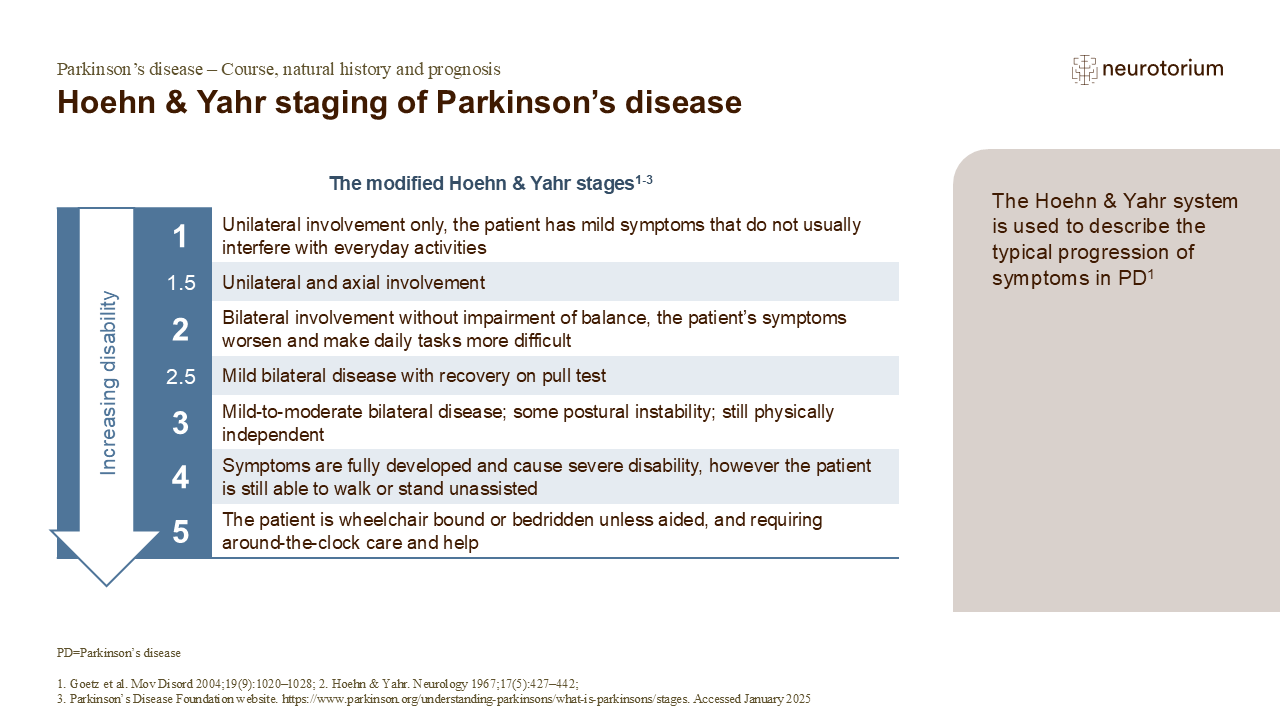
Whilst there are variations, and some people will not experience the symptoms of Parkinson’s disease progressing in the way described on the slide, the Hoehn & Yahr system is commonly used to describe the typical progression of symptoms.1,2 During early PD, patients may experience one or more motor symptoms.3 If dopaminergic treatment is initiated at this early stage, patients experience a period during which their symptoms are effectively controlled.3
The mid stage of PD is characterized by the appearance of disabling symptoms and a progressive impairment in the ability to carry out activities of daily living.3 From mid-stage disease onwards, the focus of treatment generally shifts towards achieving an optimal balance between reduction of motor symptoms and minimizing dyskinesia and other complications.4 Many patients experience a ‘non-troublesome’ amount of dyskinesia at this point, which does not necessarily require treatment, while other elements of motor function are adequately maintained.5
In the advanced stages of PD, the patient experiences continuing symptom progression, worsening of function, and fluctuations in the response to therapy.3 Patients require a high level of care and assistance with most daily activities, particularly those involving mobility and coordination.3 They may also start to experience impaired cognitive function, which is often associated with delusions and hallucinations.3 Postural instability worsens, leading to a greater risk of falls and associated fractures.6 As symptoms proliferate and become more severe, the drugs required to manage them become increasingly complex.7 Optimal control of symptoms can be difficult without inducing severe complications, and eventually many patients fail to respond to therapy, or become unable to tolerate their medication.6 Consequently, patients experience periods of time with uncontrolled motor symptoms, such as gait disorders, dysphagia (difficulty swallowing), and dysarthria (difficulty speaking).6
2.Hoehn MM, Yahr MD. Parkinsonism: onset, progression, and mortality. Neurology 1967; 17 (5): 427–442.
3.Parkinson’s Disease Foundation website. https://www.parkinson.org/understanding-parkinsons/what-is-parkinsons/stages. Accessed January 2025.