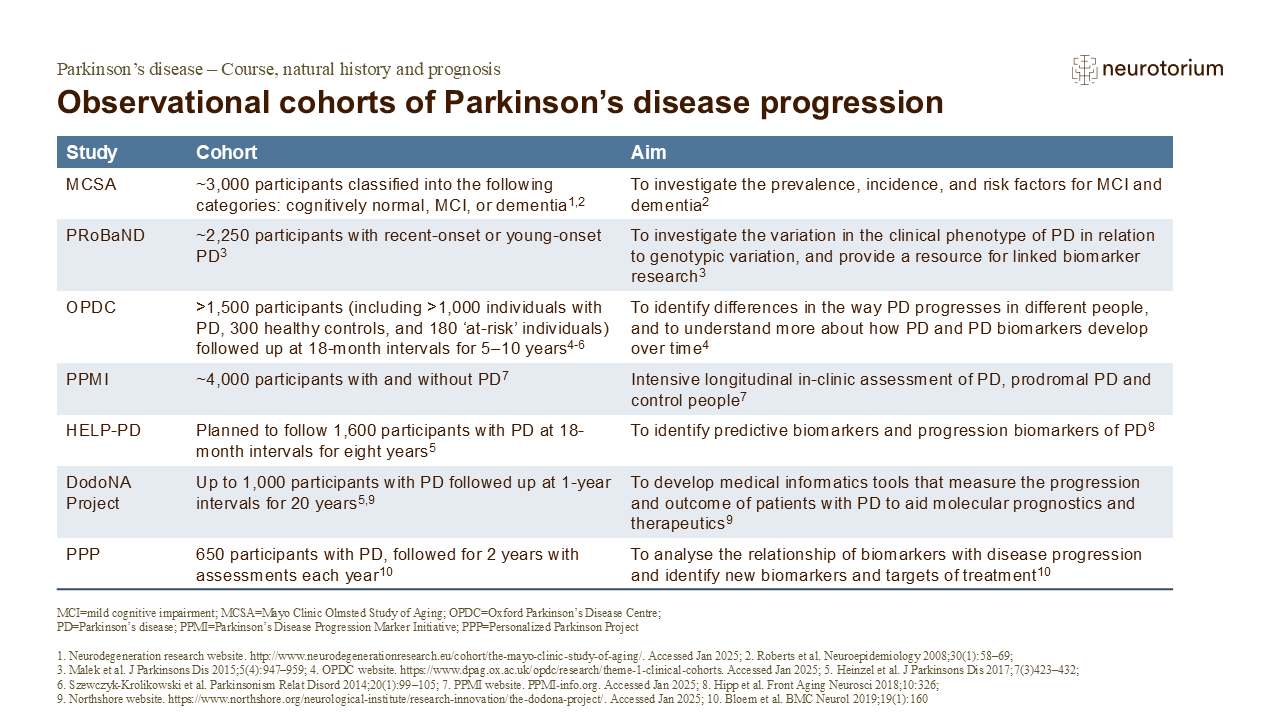
A cohort study is simply an observational study whereby a defined set of individuals are followed over a period of time.11 A review, published in 2017, identified 44 cohort studies in Parkinson’s Disease, some of which are described on the slide.5 However, research populations such as those summarized here are not a perfect representation of real-world findings, meaning that the disease progression experienced by people with Parkinson’s disease in the real world can vary from the typical clinical picture presented above quite appreciably.12
References:
1.Neurodegeneration research website. http://www.neurodegenerationresearch.eu/cohort/the-mayo-clinic-study-of-aging/. Accessed January 2025.
2.Roberts RO, Geda YE, Knopman DS, et al. The Mayo Clinic study of aging: design and sampling, participation, baseline measures and sample characteristics. Neuroepidemiology 2008; 30 (1): 58–69.
3.Malek N, Swallow DMA, Grosset KA, et al. Tracking Parkinson’s: study design and baseline patient data. J Parkinsons Dis 2015; 5 (4): 947–959.
4.OPDC website. https://www.dpag.ox.ac.uk/opdc/research/theme-1-clinical-cohorts. Accessed January 2025.
5.Heinzel S, Lerche S, Maetzler W, Berg D. Global, yet incomplete overview of cohort studies in Parkinson’s disease. J Parkinsons Dis 2017; 7 (3): 423–432.
6.Szewczyk-Krolikowski K, Tomlinson P, Nithi K, et al. The influence of age and gender on motor and non-motor features of early Parkinson’s disease: initial findings from the Oxford Parkinson Disease Center (OPDC) discovery cohort. Parkinsonism Relat Disord 2014; 20 (1): 99–105.
7.PPMI website. PPMI-info.org. Accessed January 2025.
8.Hipp G, Vaillant M, Diederich et al. The Luxembourg Parkinson’s study: a comprehensive approach for stratification and early diagnosis. Front Aging Neurosci 2018; 10: 326.
9.Northshore website. https://www.northshore.org/neurological-institute/research-innovation/the-dodona-project/. Accessed January 2025.
10.Bloem BR, Marks WJ Jr, Silva de Lima AL, et al. The Personalized Parkinson Project: examining disease progression through broad biomarkers in early Parkinson’s disease. BMC Neurol 2019; 19 (1): 160.
11.Song JW, Chung KC. Observational studies: cohort and case-control studies. Plast Reconstr Surg 2010; 126 (6): 2234–2242.
12.Beaulieu-Jones BK, Frau F, Bozzi S, et al. Disease progression strikingly differs in research and real-world Parkinson’s populations. NPJ Parkinsons Dis 2024; 10 (1): 58.