

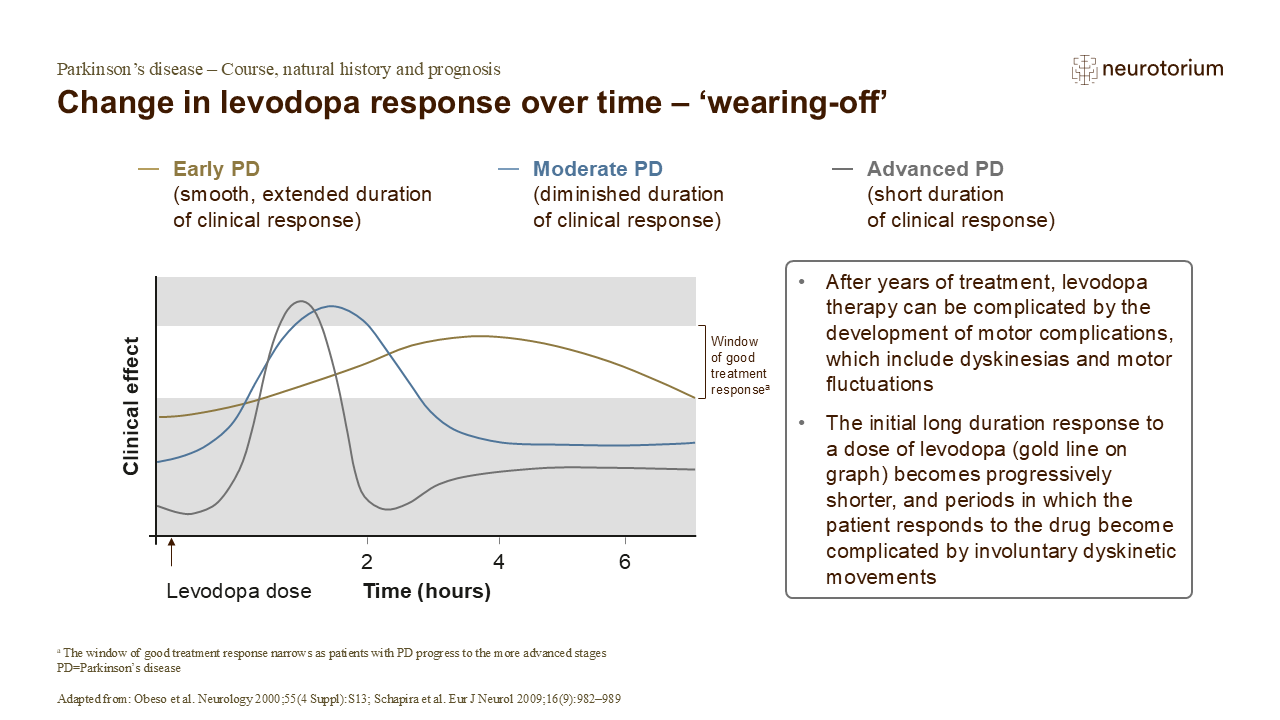
Levodopa is the major symptomatic therapy for PD and is the most common first-line therapy because it provides benefit to virtually all patients.1,3 In the short-term, the effects of levodopa tend to be long-lasting and side effects are tolerable.1 In the longer-term, however, patients may struggle to maintain good symptom control as the duration of response to levodopa therapy becomes progressively shorter.1 This problem is known as ‘wearing-off’.
‘Wearing-off’ is a predictable recurrence of PD symptoms that precedes a scheduled dose of levodopa and usually improves with medication.4 By contrast, the less predictable fluctuations – sometimes called ‘yo‑yoing’ – are associated with more advanced stages of PD.5
3.Bloem BR, Okun MS, Klein C. Parkinson’s disease. Lancet 2021; 397 (10291): 2284–2303.