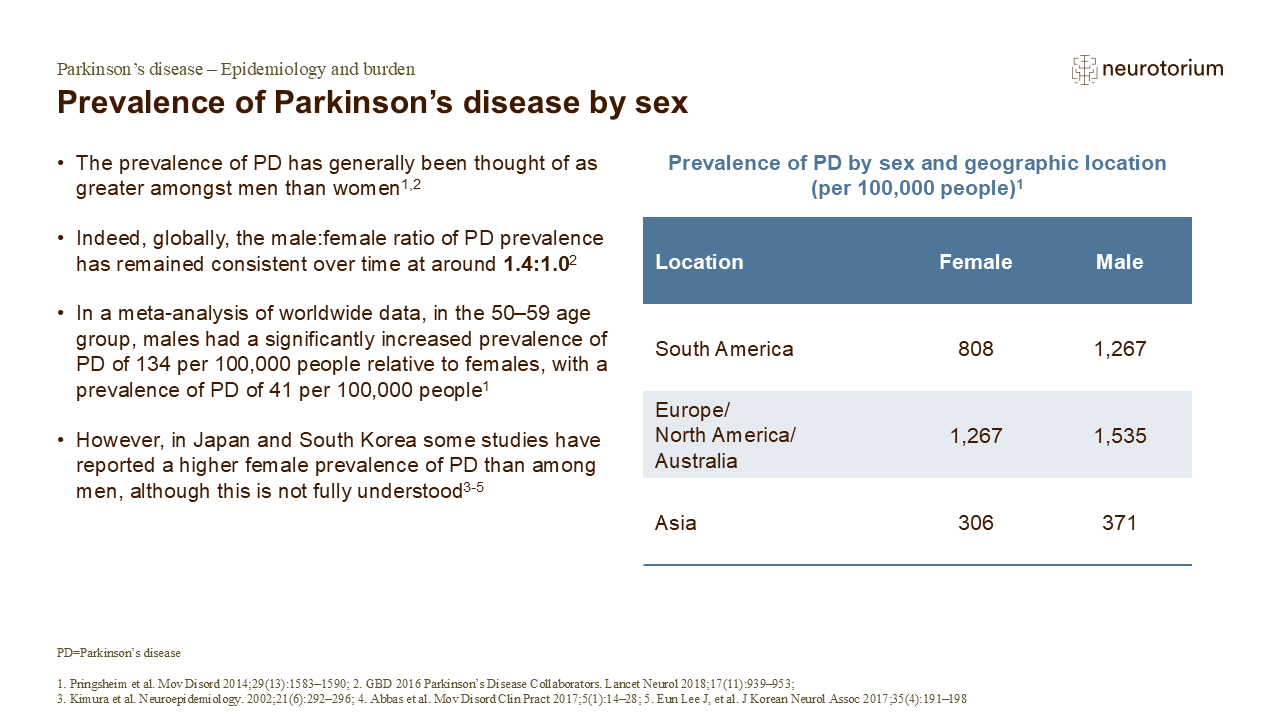
Although there is strong evidence to indicate that a person is more likely to develop PD as they become older, the effect of sex is less clear-cut.1
Analysis of worldwide data found generally higher levels of PD in male populations.1,2 However, the differences were only statistically significant in one age group (50–59 years), and not in any of the other age groups, geographical regions, or overall.1 Consequently, the observed differences may be a result of variations in the study designs.6 Some evidence is more supportive of a greater risk of PD in men than others; a review of incidence data (i.e., showing the rates at which new cases of PD occur) found that men were more likely than women to develop PD.7 However, a systematic review and meta-analysis found an overall male:female ratio of PD prevalence of 1.18 (95% confidence interval 1.03–1.36), which is much less stark a difference than previously believed.8 Understanding the reasons behind geographical differences in the male:female ratio of PD prevalence, or whether that ratio has decreased over time, requires high-quality studies in diverse populations.8
References:
1.Pringsheim T, Jette N, Frolkis A, Steeves TDL. The prevalence of Parkinson’s disease: a systematic review and meta-analysis. Mov Disord 2014; 29 (13): 1583–1590.
2.GBD 2016 Parkinson’s Disease Collaborators. Global, regional, and national burden of Parkinson’s disease, 1990–2016: a systematic analysis for the Global Burden of Disease Study 2016. Lancet Neurol 2018; 17 (11): 939–953.
3.Kimura H, Kurimura M, Wada M, et al. Female preponderance of Parkinson’s disease in Japan. Neuroepidemiology 2002; 21 (6): 292–296.
4.Abbas MM, Xu Z, Tan LCS. Epidemiology of Parkinson’s disease – East versus West. Mov Disord Clin Pract 2017; 5 (1): 14–28.
5.Eun Lee J, Choi JK, Sun Lim H, et al. The prevalence and incidence of Parkinson′s disease in South Korea: a 10-year nationwide population-based study. J Korean Neurol Assoc 2017; 35 (4): 191–198.
6.Burn DJ. Sex and Parkinson’s disease: a world of difference? J Neurol Neurosurg Psychiatry 2007; 78 (8): 787.
7.Wright Willis A, Evanoff BA, Lian M, et al. Geographic and ethnic variation in Parkinson disease: a population-based study of US Medicare beneficiaries. Neuroepidemiology 2010; 34 (3): 143–151.
8.Zirra A, Rao SC, Bestwick J, et al. Gender differences in the prevalence of Parkinson’s disease. Mov Disord Clin Pract 2022; 10 (1): 86–93.