

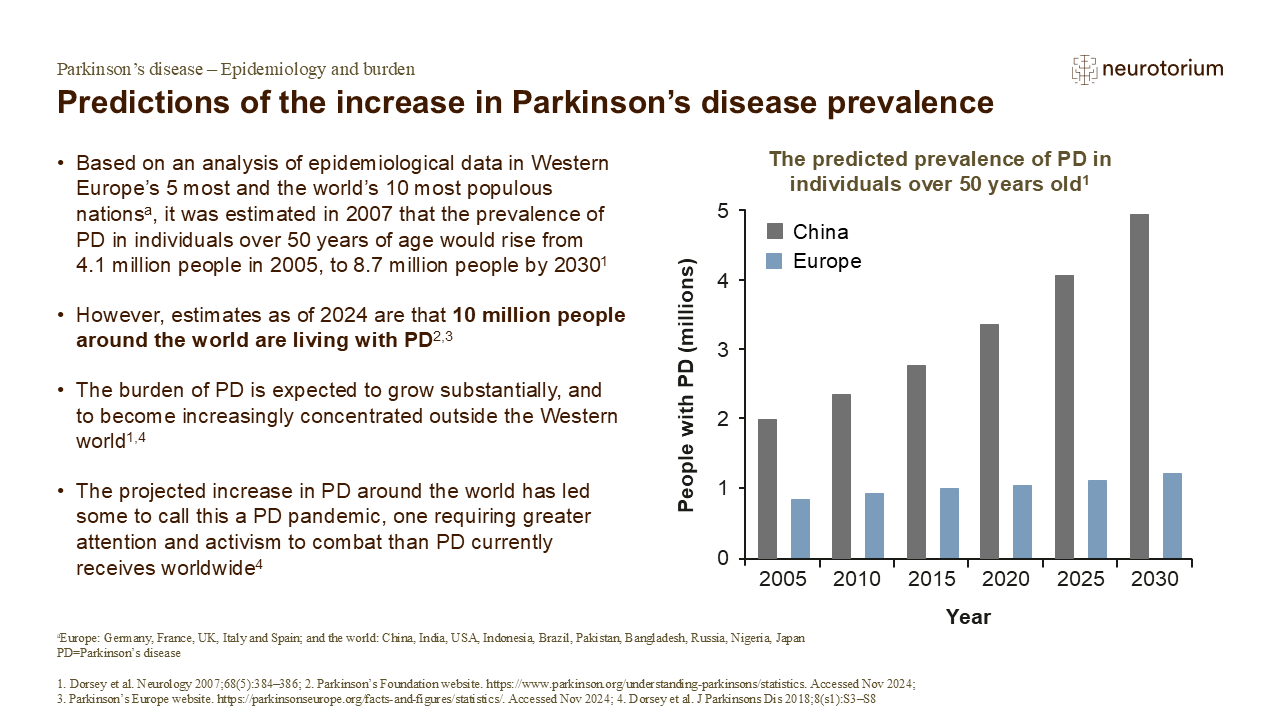
Life expectancy continues to grow in the world’s rapidly developing low- and middle-income (LMIC) countries.5 As survival rates improve, due to better economic conditions and healthcare, the prevalence of age-related chronic diseases (including PD) is expected to rise accordingly.6
A study that combined prevalence data for some of the world’s largest populations predicted that there will be approximately 8.7 million people living with PD by 2030, with nearly 5 million residing in China.1 However, as noted on the slide, this figure is thought to have been surpassed already.2,3 And unlike some other diseases, the burden of PD increases with improving socioeconomic conditions.4 Some have argued that to turn the tide of this PD pandemic, a ‘PACT’ approach is needed – to prevent, advocate for, care for, and treat PD.4
2.Parkinson’s Foundation website. Available at: https://www.parkinson.org/understanding-parkinsons/statistics. Accessed November 2024.
3.Parkinson’s Europe website. Available at: https://parkinsonseurope.org/facts-and-figures/statistics/. Accessed November 2024.
5.United Nations. World population prospects: the 2015 revision. https://esa.un.org/unpd/wpp/. Accessed March 2015.