

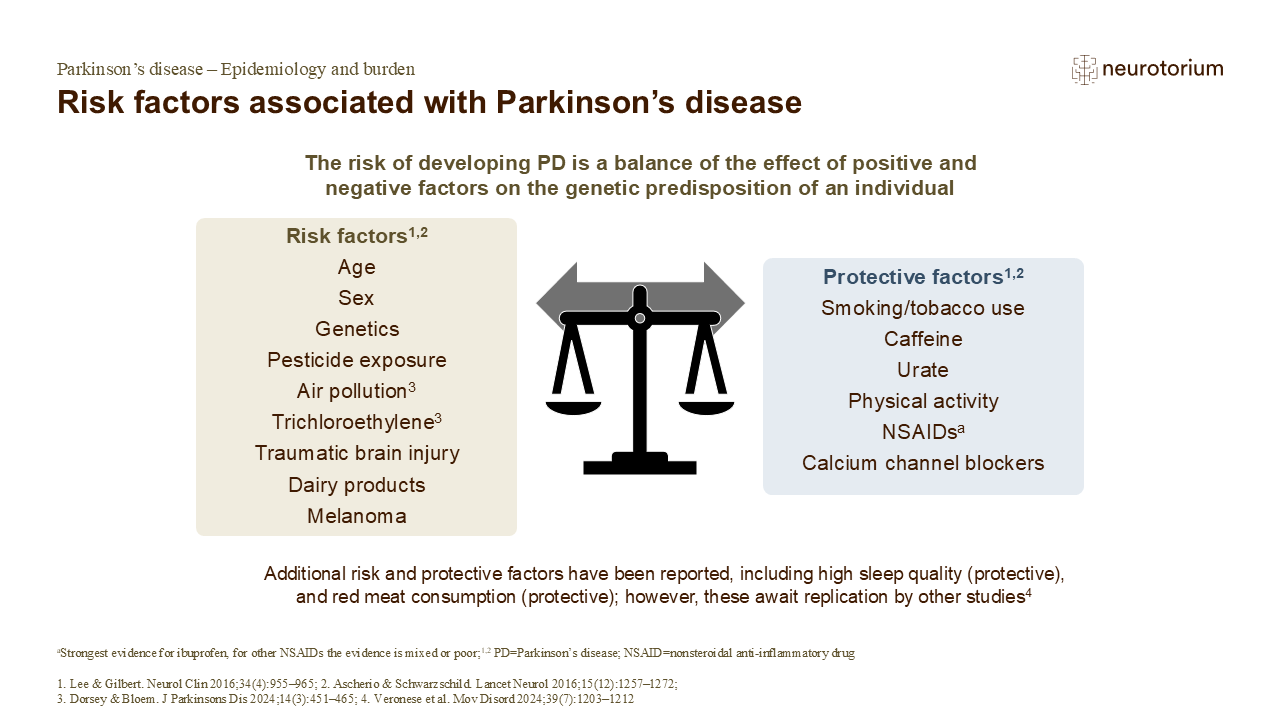
Approximately 85–95% of PD cases are ‘sporadic’ or ‘idiopathic’, meaning that the cause is unknown.5,6 However, the disease is known to cluster in families, with approximately 5–15% of patients reporting a family history of PD.5,6 There are now several well-established PD genes that cause monogenic PD – in these patients the cause of PD is attributable to rare pathogenic variants of a single gene.5-7 These genes include SNCA, LRRK2, VPS35, and RAB32 linked to autosomal dominant PD, and PRKN, PINK1, and PARK7/DJ-1 linked to autosomal recessive PD.5,7 Other PD-related genes tend to have relatively small effects by themselves, but may contribute to a substantial increase in overall risk when found together.8
Smokers tend to have a markedly lower risk of PD than non-smokers.2 While this finding has led to nicotine being tested in clinical trials as a potential therapy for PD,2 smoking itself should never be considered as a useful preventive measure, since it remains the world’s leading cause of avoidable premature death.9 Furthermore, the effect is far from clear; a study investigating treatment of PD using transdermal nicotine patches compared with placebo found that the patches did not have a clear effect on slowing the progression of PD.10
Urate is a biochemical end product of the metabolism of purines, that is normally present in the blood.2 There is convincing evidence to indicate that naturally higher levels of urate may protect against PD.2 While substances known to raise plasma urate levels (e.g., dietary fructose) have been associated with a reduced PD risk, those known to lower urate levels (e.g., dairy intake) have been associated with an increased risk of PD.2
References:
1.Lee A, Gilbert RM. Epidemiology of Parkinson disease. Neurol Clin 2016; 34 (4): 955–965.