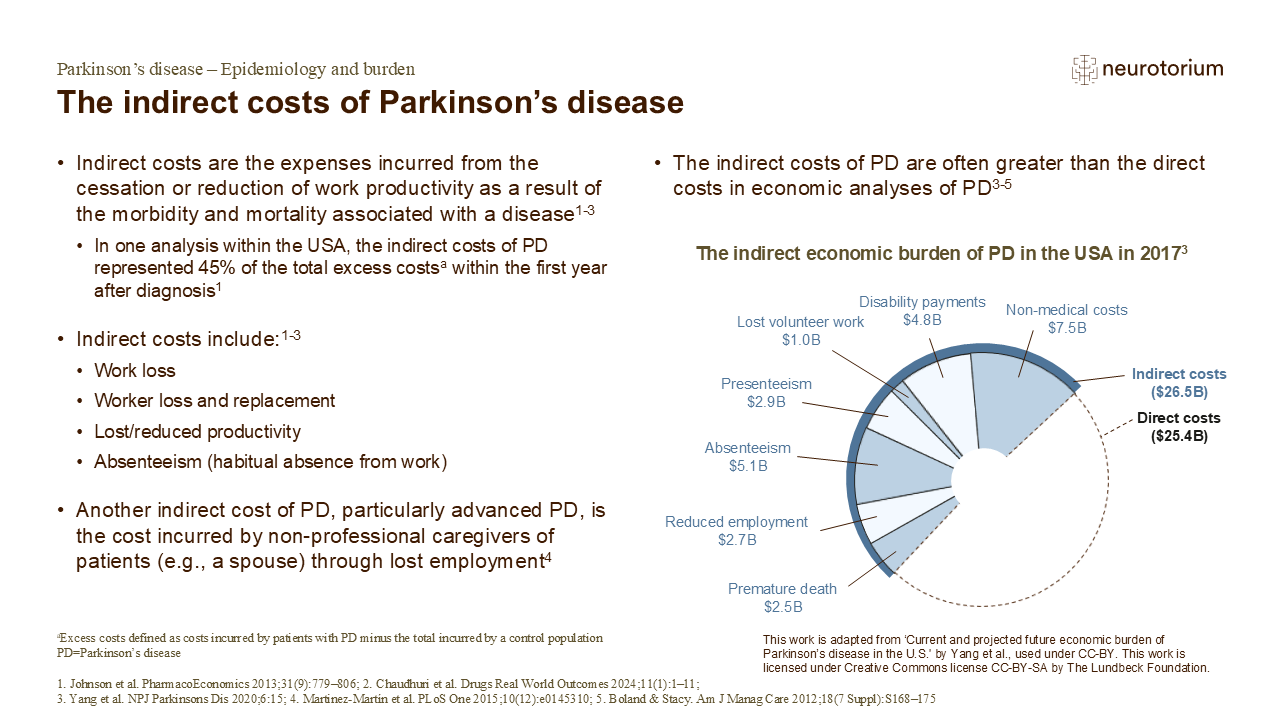
It is important to estimate indirect costs to provide an insight into the additional economic impact of a disease – beyond the more obvious costs associated with healthcare utilization.1-3 In PD, indirect costs make up a considerable proportion of the overall cost, and can be greater than the direct costs.3-5
The data shown on the slide come from an analysis of US public and private administrative claims data, which estimated a prevalence of PD in the US of approximately 1 million people, equating to a total cost of $51.9 billion.3 As shown on the slide, slightly more than half of this cost was indirect, including non-medical costs, absenteeism, and disability payments.3
References:
1.Johnson SJ, Kaltenboeck A, Diener MD, et al. Cost of Parkinson’s disease in a privately insured population. PharmacoEconomics 2013; 31 (9): 779–806.
2.Chaudhuri KR, Azulay JP, Odin P, et al. Economic burden of Parkinson’s disease: a multinational, real-world, cost-of-illness study. Drugs Real World Outcomes 2024; 11 (1): 1–11.
3.Yang W, Hamilton JL, Kopil C, et al. Current and projected future economic burden of Parkinson’s disease in the U.S. NPJ Parkinsons Dis 2020; 6: 15.
4.Martinez-Martín P, Rodriguez-Blazquez C, Paz S, et al. Parkinson symptoms and health related quality of life as predictors of costs: a longitudinal observational study with linear mixed model analysis. PLoS One 2015; 10 (12): e0145310.
5.Boland DF, Stacy M. The economic and quality of life burden associated with Parkinson’s disease: a focus on symptoms. Am J Manag Care 2012; 18 (7 Suppl): S168–S175.