

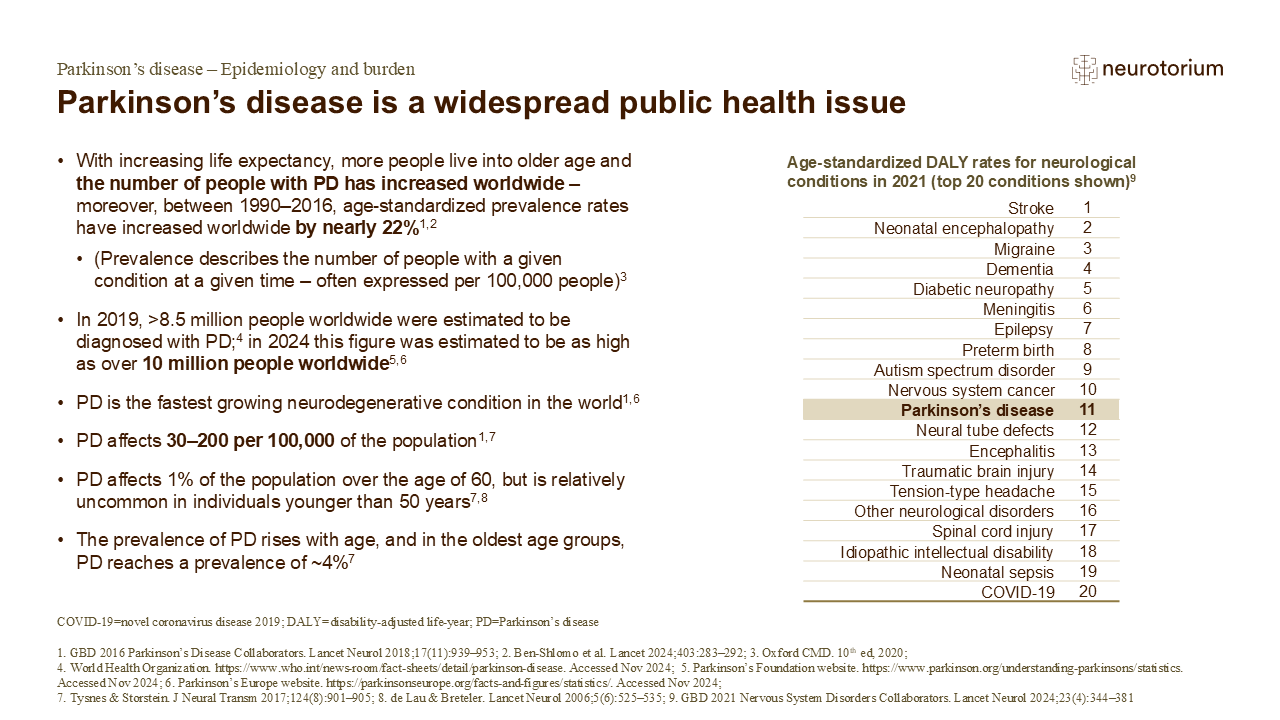
Although PD is the fastest growing neurodegenerative disorder worldwide,1,6 it is difficult to estimate the total number of people in the world who are affected by PD, as the methods used to collect these data differ between countries.10 In a study published in 2007, the prevalence of PD was predicted to increase substantially over the following few decades, estimating that, by 2030, the global prevalence of PD would more than double, to between 8.7 million and 9.3 million individuals.11 However, as stated on the slide, estimates already place the number of people worldwide with Parkinson’s disease at over 10 million.5,6
The fact that PD is a prevalent disease that is costly to manage means that it has become an important public health issue.4
3.Oxford Concise Medical Dictionary. Tenth Edition. © Oxford University Press, 2020.
4.World Health Organization. Parkinson disease fact sheet. Available at: https://www.who.int/news-room/fact-sheets/detail/parkinson-disease. Accessed November 2024.
5.Parkinson’s Foundation website. Available at: https://www.parkinson.org/understanding-parkinsons/statistics. Accessed November 2024.
6.Parkinson’s Europe website. Available at: https://parkinsonseurope.org/facts-and-figures/statistics/. Accessed November 2024.
7.Tysnes OB, Storstein A. Epidemiology of Parkinson’s disease. J Neural Transm 2017; 124 (8): 901–905.
8.de Lau LML, Breteler MMB. Epidemiology of Parkinson’s disease. Lancet Neurol 2006; 5 (6): 525–535.