

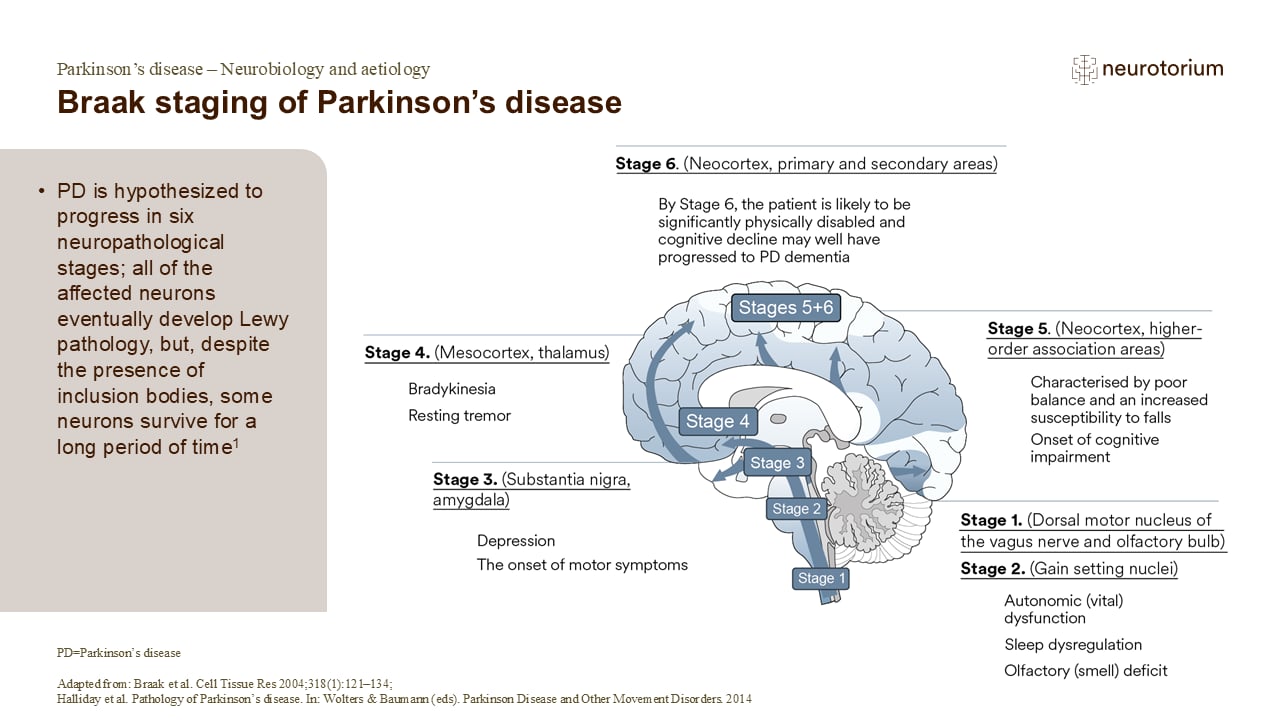
At a physiological level, PD is characterized by the loss of neurons in specific regions of the brain and a spreading of Lewy pathology.2 However, these do not necessarily always go together; many regions with a concentration of Lewy pathology show only mild neuronal loss.2
The widely-used scheme proposed by Braak and colleagues categorizes PD into discrete stages of neuropathological progression.1,2 The first two stages involve early α‑synuclein deposition associated with the appearance of non-motor symptoms, such as olfactory (smell) and autonomic dysfunction.2 As the disease progresses, other aspects of brain function may become impaired, causing sleep dysregulation and/or depression in some individuals.2
Stage 4 is typically the point at which clinical diagnosis occurs, since this stage involves the onset of motor symptoms, such as resting tremor and bradykinesia.2 Stage 5 is characterized by poor balance and an increased susceptibility to falls, as well as the onset of cognitive impairment.2 By Stage 6, the patient is likely to be significantly physically disabled and cognitive decline may well have progressed to PD dementia.1,2
The Braak staging scheme is a useful concept to distinguish between the different phases of PD.1 Some have suggested that the Braak staging concepts may be more useful still if combined with more modern staging models that take into account some of the advancements in PD biomarker research.3 However, in reality, patients vary considerably in the extent to which they conform to this model.2 In one study, less than half of all patients with PD whose brains were examined post-mortem showed a close fit to the Braak staging scheme.4 Another study found no pathology in the lower brainstem of some individuals (normally affected in Stage 1), even though it was clearly evident in higher regions.5 Together, these studies clearly demonstrate that, beneath the over-arching diagnosis of ‘idiopathic PD’, there exists a variety of different disease processes.2
2.Halliday GM, Murphy K, Cartwright H. Pathology of Parkinson’s disease. In: Wolters & Baumann (eds). Parkinson Disease and Other Movement Disorders. VU University Press, 2014.
3.Del Tredici K, Braak H. To stage, or not to stage. Curr Opin Neurobiol 2020; 61: 10–22.