

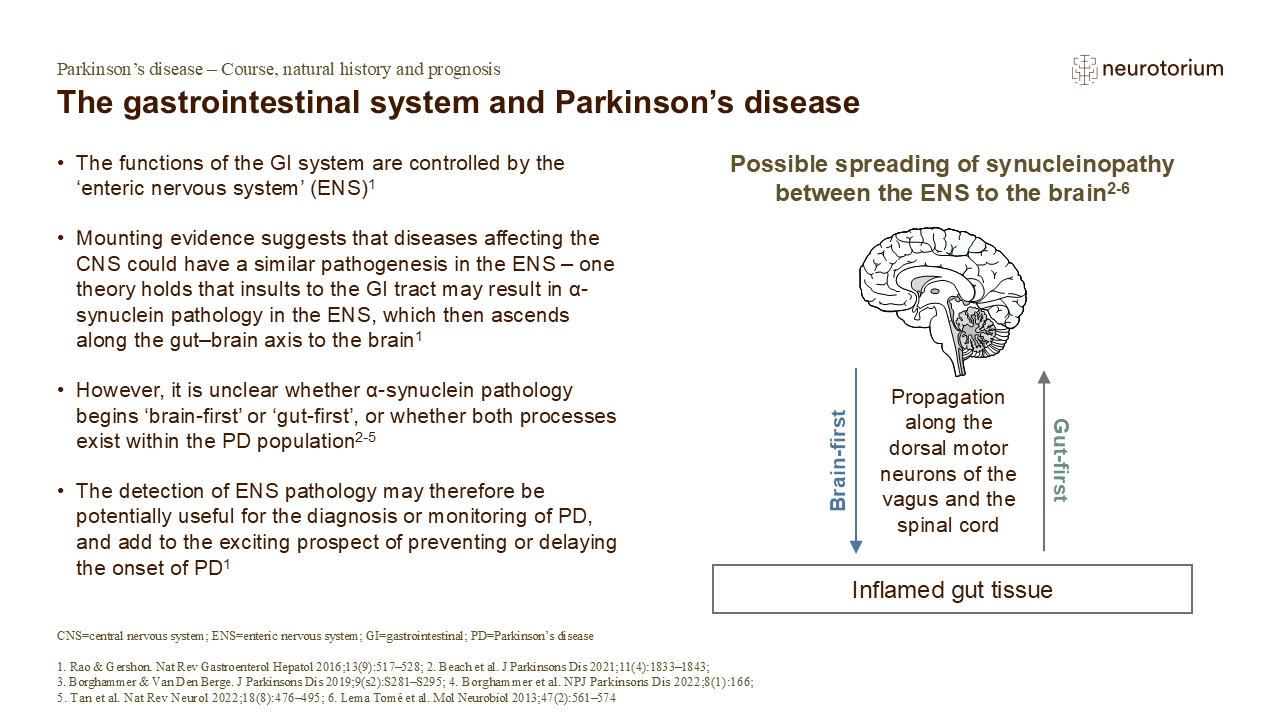
Neurons found in the enteric (gut) nervous system (ENS) require dopamine.1 Without dopamine, these neurons cannot properly control gastrointestinal motility.1 Animal studies have suggested that the ENS may be vulnerable to degeneration during PD, and the finding of Lewy pathology in gut biopsy samples taken from patients with PD supports this.1 It may, therefore, be useful to measure levels of α-synuclein in the gut as a method of potentially diagnosing PD during its early stages.1 However, it is not yet understood how the ‘brain-first’ and the ‘gut-first’ ideas might interact, and whether both processes can exist.2,4
A gut-derived biomarker may be particularly valuable if, as some studies have suggested, PD develops first in the ENS and then moves up into the brainstem via nerve fibres.1 Experimental data using rodents have recently demonstrated (as a proof of concept) that the application of a toxin to the gastrointestinal system can lead to neurodegeneration in the central nervous system, including the brain.1 This ‘gut–brain’ hypothesis is further supported by epidemiological data that indicate a reduced risk of PD in individuals who had undergone truncal vagotomy, an operation that severs the vagus nerve connecting the ENS to the brain.7