

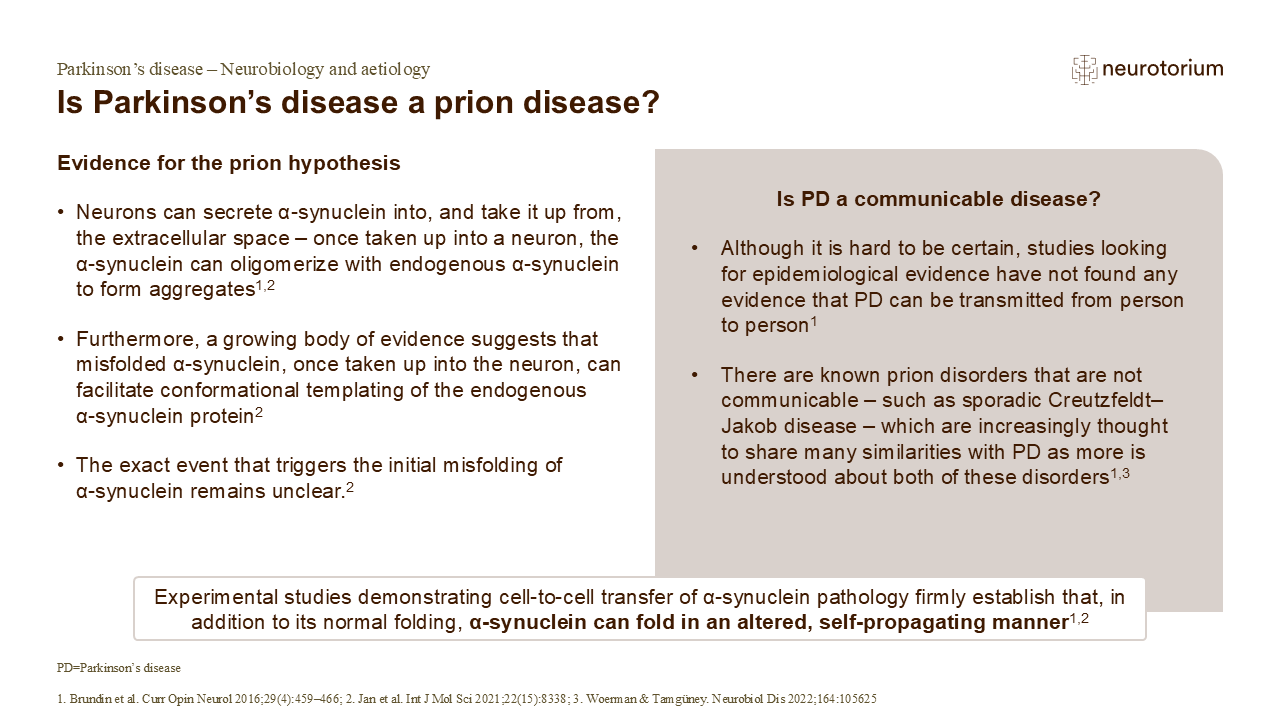
In the 1990s, a small cohort of patients with PD received striatal transplants of foetal dopaminergic neurons in an attempt to compensate for lost capacity in the substantia nigra.4,5 The brain of one of these patients was examined after her death 14 years later.4,5 During the examination, it was observed that some of the grafted neurons in the patient’s brain tissue contained Lewy body-like inclusions that stained positively for α-synuclein, indicating its presence in the tissue.5 Although the patient had responded well to dopaminergic therapy for several years after her transplant, her symptoms had worsened again over time, which suggests that the striatal transplants had deteriorated due to α-synuclein-related pathology.5 This finding was subsequently confirmed in several similar clinical cases and replicated in animal models, including an experiment in which α-synuclein fibrils were injected into the olfactory bulb of mouse brains.6,7 These fibrils ‘recruited’ normal α-synuclein to become insoluble aggregates, which then spread into other areas of the brain, causing loss of olfactory function.7
When viewed as a prion-like disease, there are some new avenues to studying PD aetiology that open up.8 There are some in vitro α-synuclein fibrillization assays, cell models of α-synuclein spreading, and animal models that can be used to study prion pathology.8 Moreover, the prion-like features of PD could be used to stage PD, with the potential of powerful new biomarkers and early diagnosis.8