

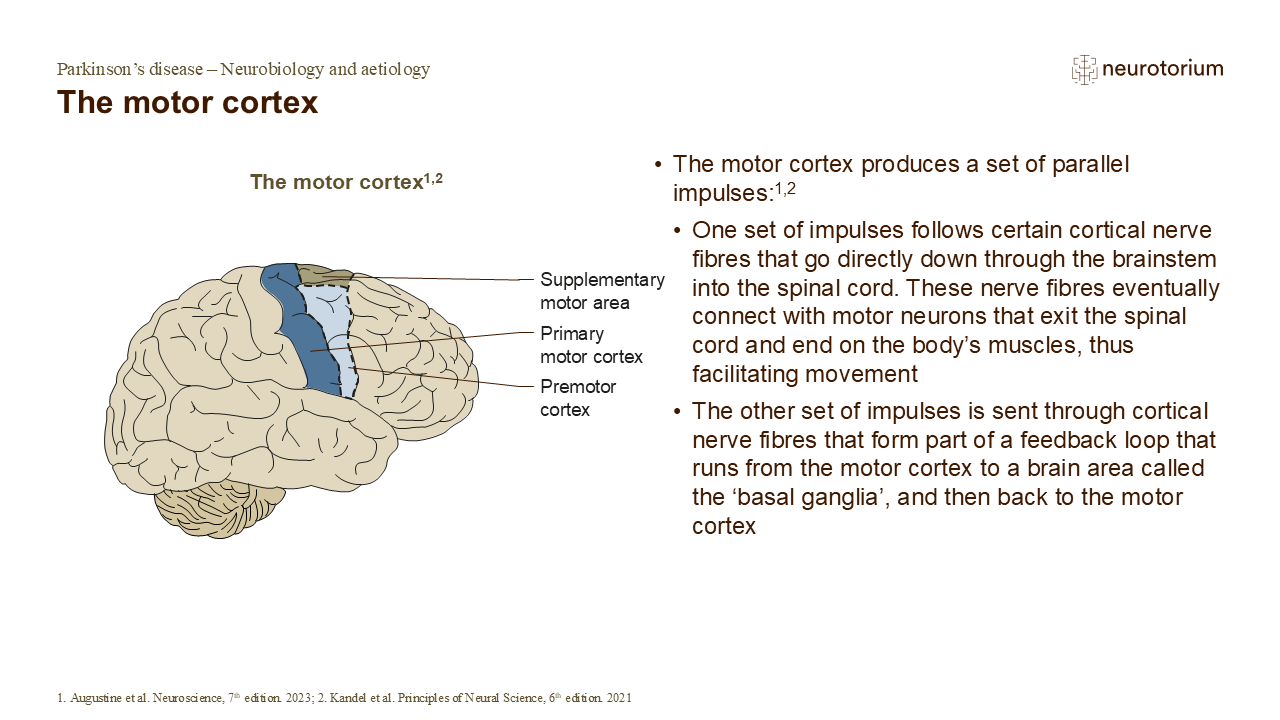
Motor activity is controlled by projections that range from the primary motor cortex and the premotor cortical areas of the frontal lobe through to the brainstem and spinal cord.3 The primary motor cortex has an important function in the execution of distinct, well-defined, voluntary motor activity.2
A striking characteristic of the primary motor cortex in humans is that over half of it is associated with the motor activity of the hands, tongue, lips, and larynx, reflecting the manual dexterity and ability for speech possessed by humans.3 The primary motor cortex also influences the motor control of muscles in the trunk and head regions, as well as control of distal muscles in the upper and lower limbs – i.e., those muscles that control movements of the hands and feet.3
References:
1.Augustine GJ, Groh JM, Huettel SA, et al. Neuroscience, 7th edition. New York, USA: Oxford University Press, 2023.