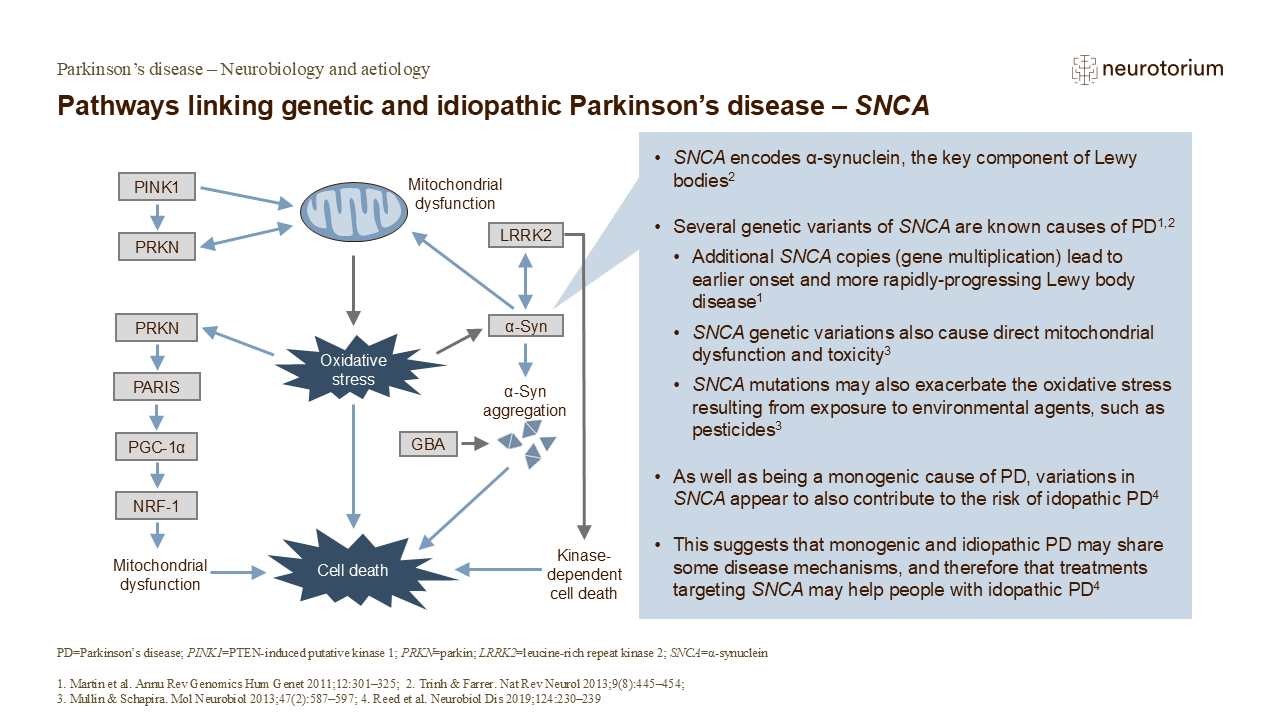
Linkage analysis studies have identified several SNCA genetic variations associated with familial PD.4 These mutations include dominantly inherited substitutions, such as Ala30Pro and Ala53Thr, as well as multiplication events – i.e., duplications and triplications.4 Triplication of SNCA leads to greater expression of α-synuclein, as compared with duplication, as well as an earlier onset and faster progression of PD, which suggests that the severity of PD may be partly dose-dependent upon α-synuclein levels.1,2,4 This has led to the widely held hypothesis that enhanced activity of α-synuclein underlies pathogenesis in PD.1,2,4 Indeed, since expression of SNCA increases with age in brains unaffected by PD, some investigators have proposed that PD is actually an accelerated variant of the normal process of ageing, with the inadequate degradation of overexpressed α-synuclein playing a central role.3 As well as causing autosomal dominant forms of PD, there are SNCA variants that broadly appear to increase the activity of α-synuclein that are linked with idiopathic PD, i.e., they appear to increase disease risk but not directly cause PD.4
Pathways linking genetic and idiopathic Parkinson’s disease – SNCA