

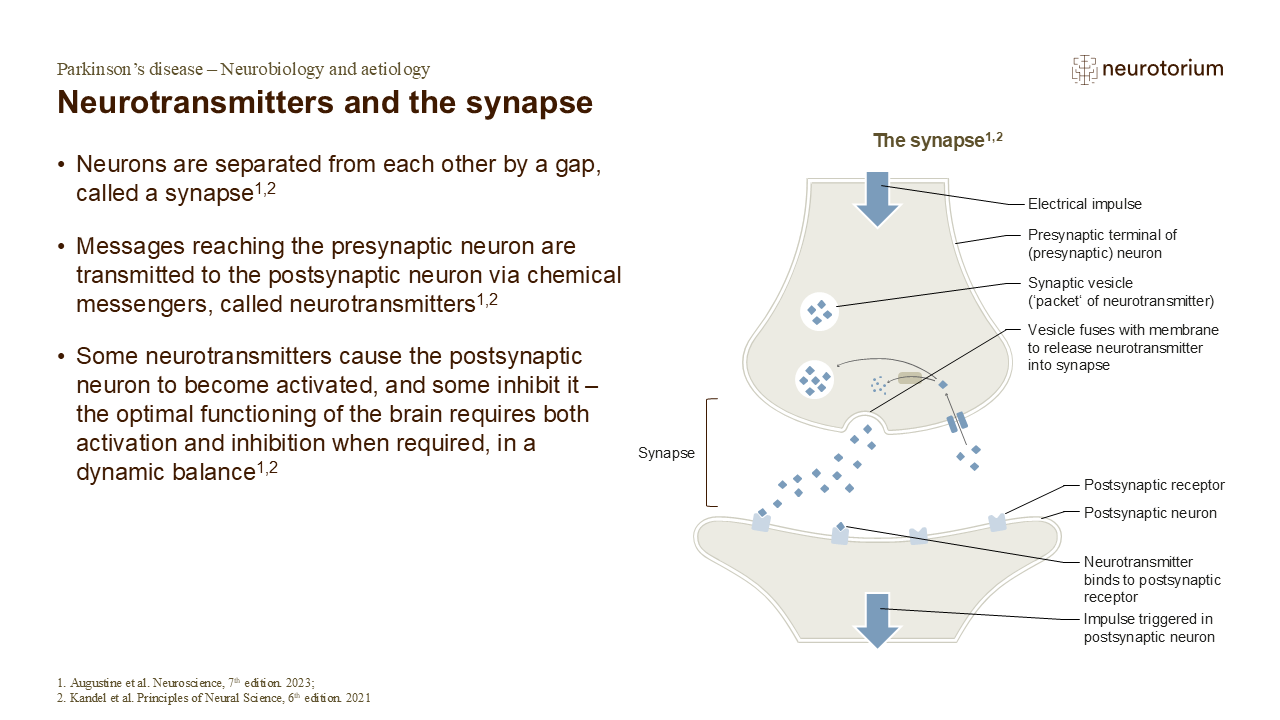
Cells of the nervous system communicate with each other at synapses, either via electrical signals or by the release of messenger molecules called neurotransmitters.1,2 Examples of neurotransmitters include: acetylcholine, adrenaline, dopamine, serotonin, glutamate, and histamine.1,2
Neurotransmitters are characterized by five basic qualities:3
- they are synthesized by presynaptic neurons
- they reside within synaptic terminals, enclosed in vesicles
- they are released from presynaptic terminals by way of a calcium-dependent mechanism
- they bind to specific receptors on the postsynaptic membrane
- they are inactivated in the synaptic cleft.
Neurotransmitters can either bind to ion channels, in which case they have a direct and immediate effect on post-synaptic function, or they can bind to G-protein-coupled receptors, which results in an indirect and slower effect.3 For this reason, neurotransmitters falling into the latter category are sometimes referred to as ‘neuromodulators’.3
References:
1.Augustine GJ, Groh JM, Huettel SA, et al. Neuroscience, 7th edition. New York, USA: Oxford University Press, 2023.