

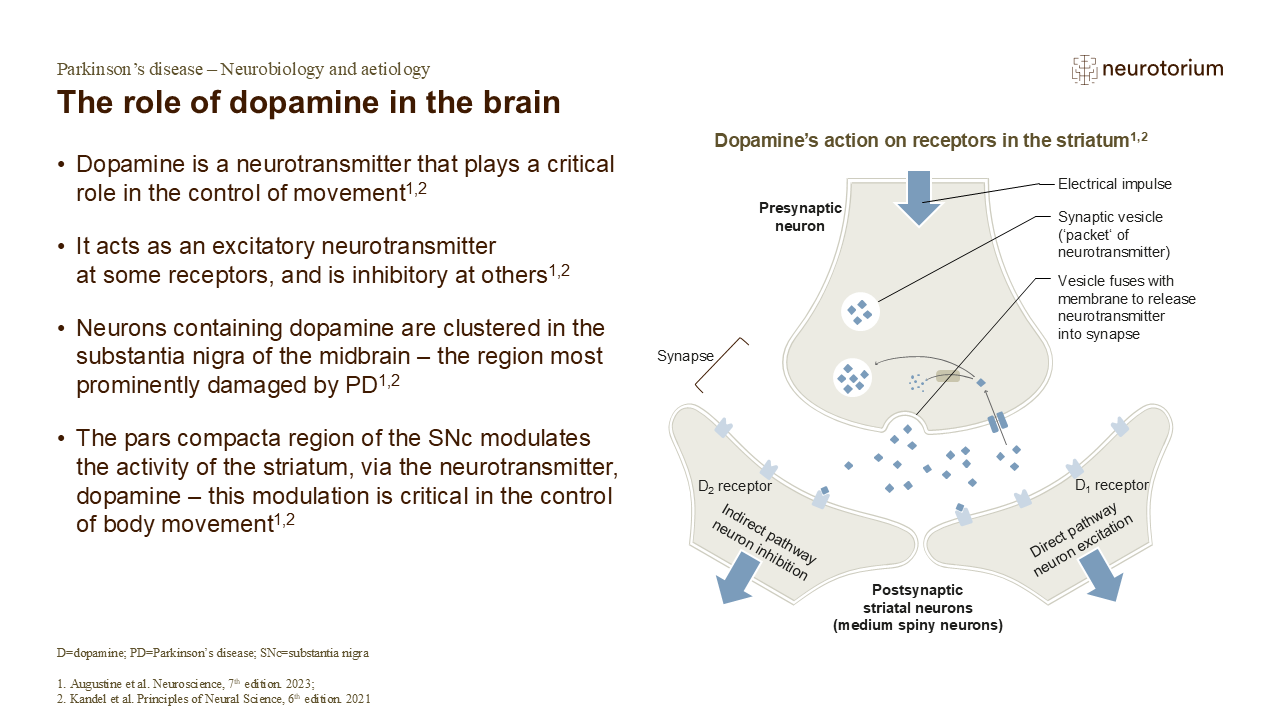
Dopamine is an excitatory neurotransmitter present in the neurons of several regions of the central nervous system.1,2 A major dopamine-containing area is the striatum, which plays a central role in the coordination of body movements.1,2 In addition to the striatum, dopamine is also a key neurotransmitter for other regions, including:1-3
- the substantia nigra pars compacta, the axons of which project to the striatum as part of the dopaminergic nigrostriatal pathway
- the ventral tegmentum, the axons of which project to the limbic system; the ventral tegmentum constitutes a vital part of the dopaminergic reward system that governs motivation and emotional reinforcement
- the arcuate nucleus, which regulates the functions of several important hormones and vital physiological functions, such as feeding and cardiovascular function.
References:
1.Augustine GJ, Groh JM, Huettel SA, et al. Neuroscience, 7th edition. New York, USA: Oxford University Press, 2023.