

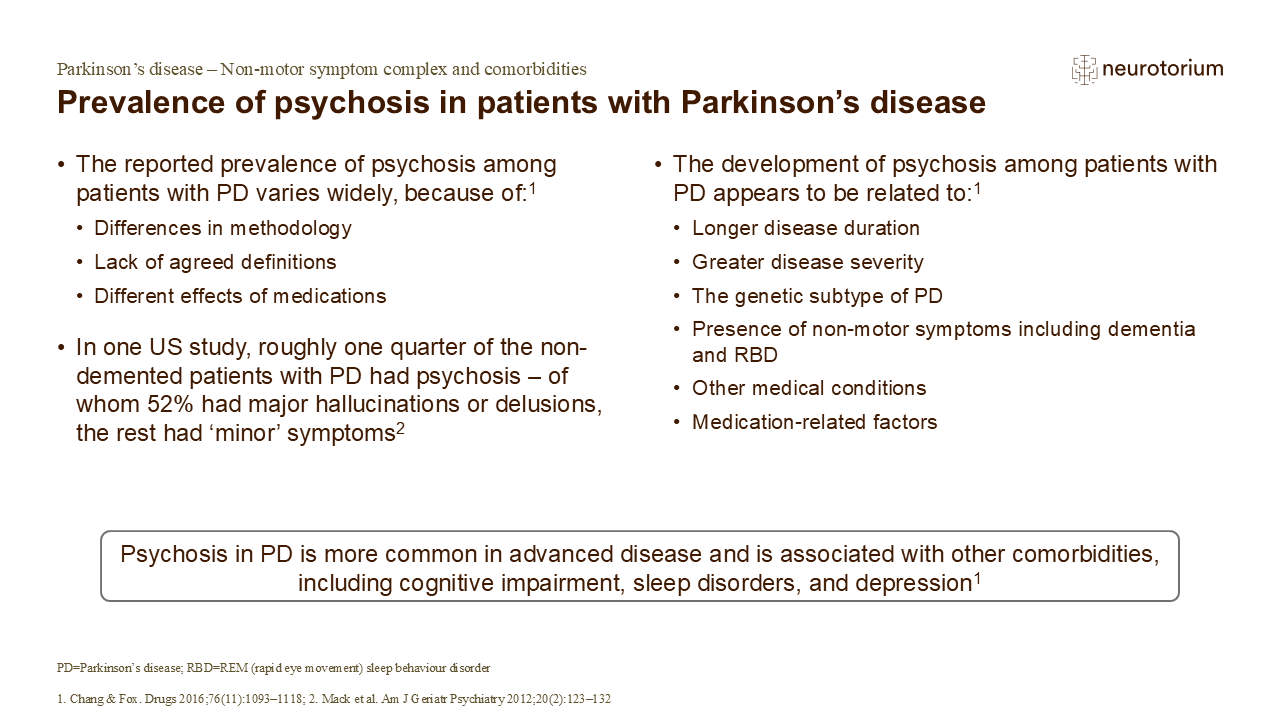
Visual hallucinations appear to be the most common psychotic symptom in PD; estimates suggest that 16–38% of patients experience them at some point.1 Auditory hallucinations are less common (0–22%) and usually occur alongside visual hallucinations.1
Delusions are least common (1–7%), but occur more often in patients with dementia.1They are probably the most significant and disabling of all the psychotic symptoms.1 Often paranoid in nature, delusions may cause great distress to the patient and their caregivers.3
A study that assessed patients with PD after 12 years of follow-up found that 60% had evidence of hallucinations or delusions.4 Those most likely to develop psychotic symptoms later during the disease were patients who:4
- were older at the onset of motor symptoms
- had a higher initial levodopa dose
- who had been suffering from REM sleep behaviour disorder (RBD).
References:
1. Chang A, Fox SH. Psychosis in Parkinson’s disease: epidemiology, pathophysiology, and management. Drugs 2016; 76 (11): 1093–1118.
3. Friedman JH. Parkinson disease psychosis: update. Behav Neurol 2013; 27 (4): 469–477.