

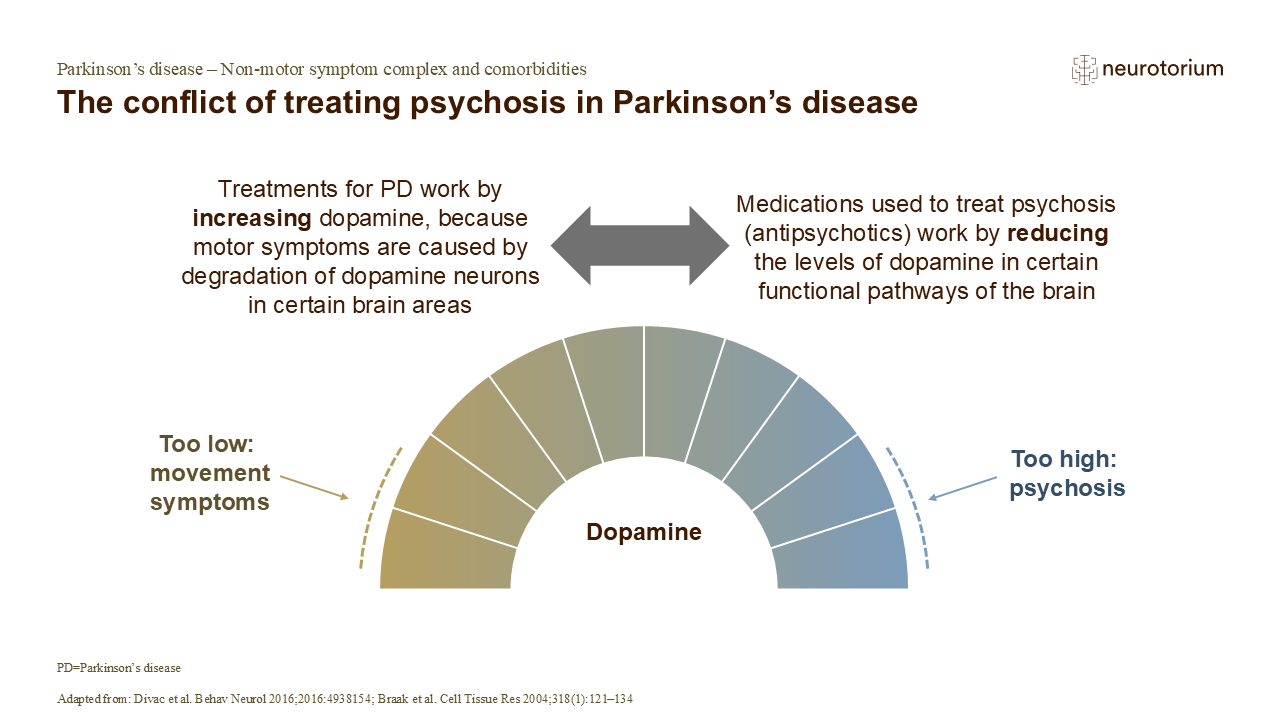
One of the main challenges of treating psychotic symptoms in PD is that many antipsychotic medications have an anti-dopaminergic effect, i.e., they block the action of dopamine.1 In doing so, antipsychotics counteract the action of levodopa and can worsen the control of motor symptoms.1 Patients are therefore caught ‘between a rock and a hard place’, feeling unable to take antipsychotic medications without incurring a worsening of physical symptoms.1 Newer drugs can be effective in treating psychotic symptoms, but with a less potent dopamine-blocking action.1 These are sometimes referred to as ‘atypical antipsychotics’.3
The symptoms of psychosis are thought to be more complex than aberrant dopamine signalling.4 In patients with PD, there is evidence for acetylcholine and serotonin signalling, as well as dopamine neurotransmission, being involved in the pathophysiology of psychosis.3