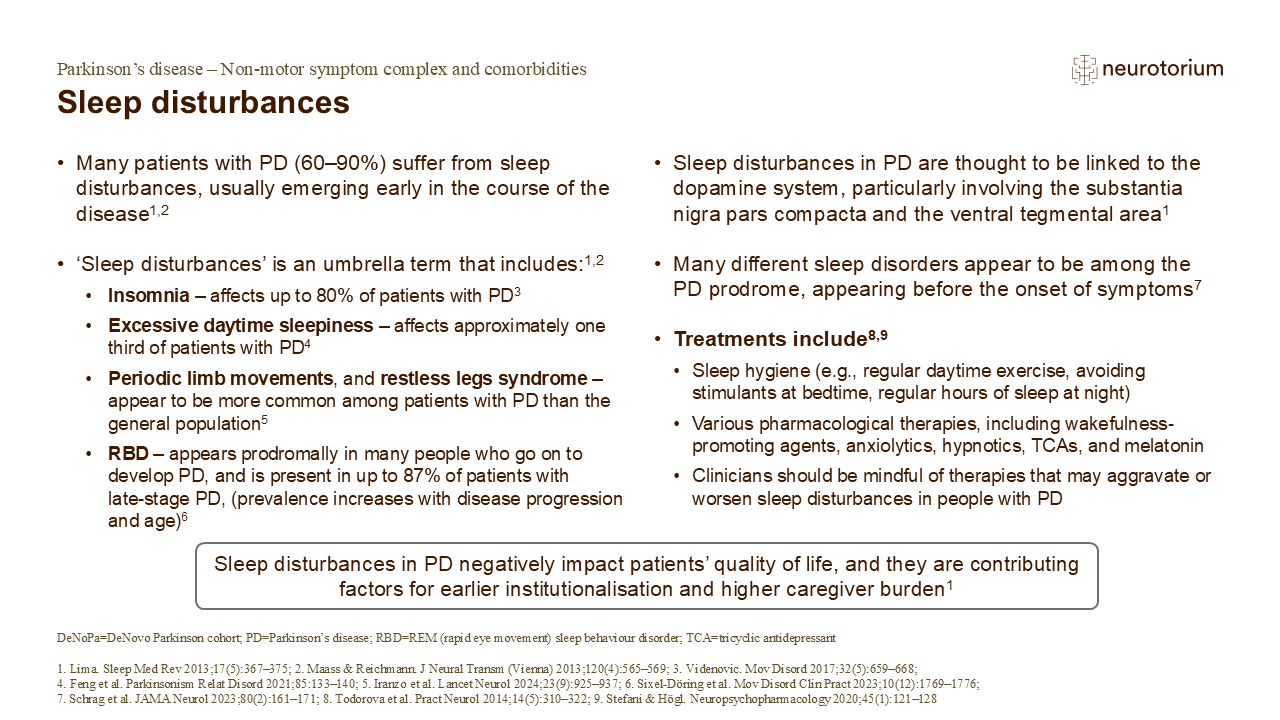
Sleep disturbances are amongst the most troublesome of the non-motor symptoms of PD, affecting 60–90% of patients at some point in the disease course.2 Sleep disturbances can take the form of insomnia, excessive daytime sleepiness, restless legs syndrome (where the patient has an urge to move), and rapid eye movement (REM) sleep behaviour disorder (RBD).1
RBD is a characteristic feature of PD and may precede the onset of motor symptoms by many years.7,10,11 It is highly prevalent in patients with PD,1 and involves the loss of normal atonia (muscle paralysis) of REM sleep, resulting in an apparent acting out of dreams.10 The presence of RBD in prodromal PD may be caused by the underlying Lewy pathology in the lower brainstem, which tends to occur before the pathology moves up into the substantia nigra.10,11 As well as RBD, several different disorders of sleep appear to be more common among people who go on to develop PD compared with controls, including anosmia, parasomnias, and sleep apnoea.7
Sleep disorders can be managed with a combination of behavioural and pharmacological therapies, including a reduction in stimulant intake, better sleep hygiene, adjustment of the sleeping environment to prevent injury of patients with RBD, greater levels of physical activity, and certain drug therapies, being mindful of the potential of some pharmacotherapies to worsen some elements of sleep disturbance.8,9,12
References:
1. Lima MM. Sleep disturbances in Parkinson’s disease: the contribution of dopamine in REM sleep regulation. Sleep Med Rev 2013; 17 (5): 367–375.
2. Maass A, Reichmann H. Sleep and non-motor symptoms in Parkinson’s disease. J Neural Transm (Vienna) 2013; 120 (4): 565–569.
3. Videnovic A. Management of sleep disorders in Parkinson’s disease and multiple system atrophy. Mov Disord 2017; 32 (5): 659–668.
4. Feng F, Cai Y, Hou Y, et al. Excessive daytime sleepiness in Parkinson’s disease: a systematic review and meta-analysis. Parkinsonism Relat Disord 2021; 85: 133–140.
5. Iranzo A, Cochen De Cock V, Fantini ML, et al. Sleep and sleep disorders in people with Parkinson’s disease. Lancet Neurol 2024; 23 (9): 925–937.
6. Sixel-Döring F, Muntean ML, Petersone D, et al. The increasing prevalence of REM sleep behavior disorder with Parkinson’s disease progression: a polysomnography-supported study. Mov Disord Clin Pract 2023; 10 (12): 1769–1776.
7. Schrag A, Bohlken J, Dammertz L, et al. Widening the spectrum of risk factors, comorbidities, and prodromal features of Parkinson disease. JAMA Neurol 2023; 80 (2): 161–171.
8. Todorova A, Jenner P, Ray Chaudhuri K. Non-motor Parkinson’s: integral to motor Parkinson’s, yet often neglected. Pract Neurol 2014; 14 (5): 310–322.
9. Stefani A, Högl B. Sleep in Parkinson’s disease. Neuropsychopharmacology 2020; 45 (1): 121–128.
10. St Louis EK, Boeve AR, Boeve BF. REM sleep behavior disorder in Parkinson’s disease and other synucleinopathies. Mov Disord 2017; 32 (5): 645–658.
11. Zhang J, Xu CY, Liu J. Meta-analysis on the prevalence of REM sleep behaviour disorder symptoms in Parkinson’s disease. BMC Neurol 2017; 17 (1): 23.
12. Cusso ME, Donald KJ, Khoo TK. The impact of physical activity on non-motor symptoms in Parkinson’s disease: a systematic review. Front Med (Lausanne) 2016; 3: 35.