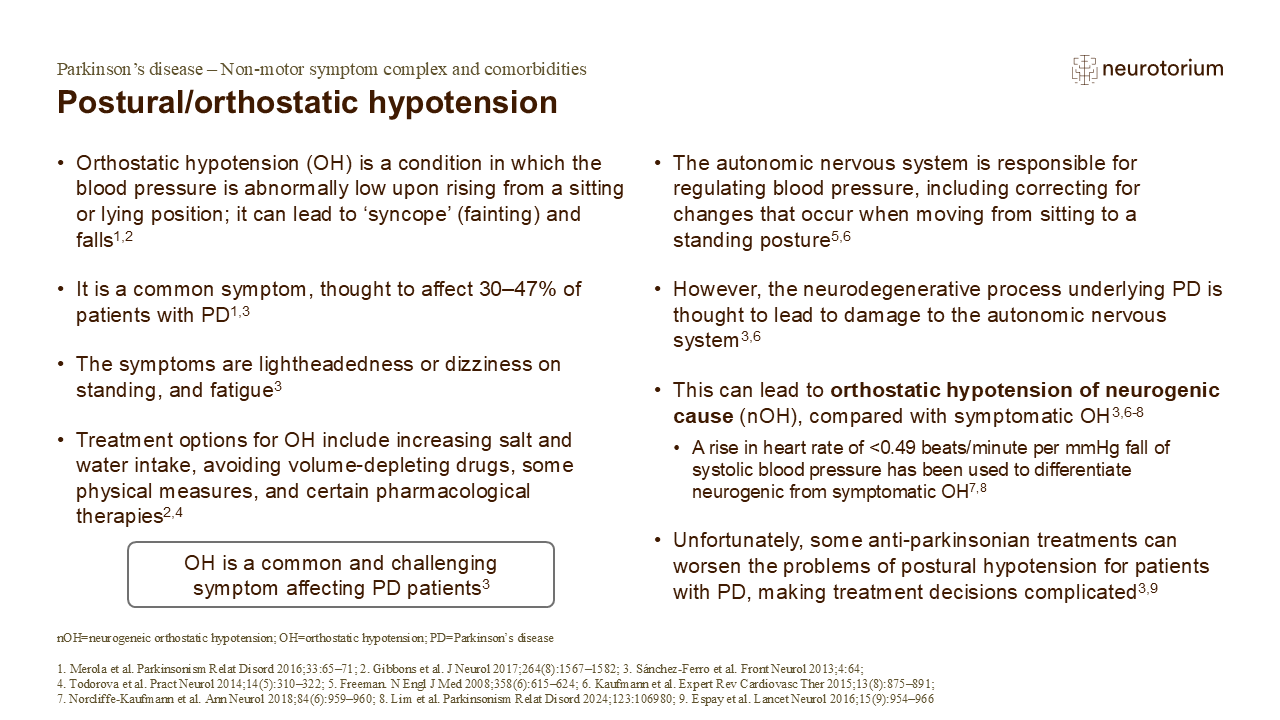
Postural, or ‘orthostatic’, hypotension is a common and sometimes disabling cardiovascular symptom of PD, affecting >30% of patients with PD.3 It is characterised by a sustained reduction of systolic blood pressure of at least 20 mmHg, or diastolic blood pressure of 10 mmHg, within three minutes of standing or head-up tilt to at least 60° on a tilt table.10
Postural hypotension may cause serious morbidity and mortality, particularly when it results in the patient falling.3 Many of the commonly prescribed medications used for PD may increase the frequency of postural hypotension and, for this reason, it may be prudent to monitor blood pressure after the introduction of a new drug to the treatment regimen or an alteration in dose.3
Non-pharmacological interventions are generally the first form of therapy used to reduce postural hypotension, because they are least likely to have side effects or adverse outcomes.3 One of the simplest and most common interventions is increased fluid and salt intake, which has been shown in other autonomic disorders to be effective in combatting postural hypotension, although not in PD itself.3
A patient suffering from postural hypotension can also learn physical countermeasures that will promote return of blood flow and maintain cardiac output.3 These include tiptoeing, leg crossing, bending forward, and squatting.3
References:
1. Merola A, Romagnolo A, Rosso M, et al. Orthostatic hypotension in Parkinson’s disease: does it matter if asymptomatic? Parkinsonism Relat Disord 2016; 33: 65–71.
2. Gibbons CH, Schmidt P, Biaggioni I, et al. The recommendations of a consensus panel for the screening, diagnosis, and treatment of neurogenic orthostatic hypotension and associated supine hypertension. J Neurol 2017; 264 (8): 1567–1582.
3. Sánchez-Ferro A, Benito-León J, Gómez-Esteban JC. The management of orthostatic hypotension in Parkinson’s disease. Front Neurol 2013; 4: 64.
4. Todorova A, Jenner P, Ray Chaudhuri K. Non-motor Parkinson’s: integral to motor Parkinson’s, yet often neglected. Pract Neurol 2014; 14 (5): 310–322.
5. Freeman R. Clinical practice. Neurogenic orthostatic hypotension. N Engl J Med 2008; 358 (6): 615–624.
6. Kaufmann H, Norcliffe-Kaufmann L, Palma JA. Droxidopa in neurogenic orthostatic hypotension. Expert Rev Cardiovasc Ther 2015; 13 (8): 875–891.
7. Norcliffe-Kaufmann L, Palma JA, Kaufmann H. A validated test for neurogenic orthostatic hypotension at the bedside. Ann Neurol 2018; 84 (6): 959–960.
8. Lim KB, Lim SY, Hor JW, et al. Orthostatic hypotension in Parkinson’s disease: sit-to-stand vs. supine-to-stand protocol and clinical correlates. Parkinsonism Relat Disord 2024; 123: 106980.
9. Espay AJ, LeWitt PA, Hauser RA, et al. Neurogenic orthostatic hypotension and supine hypertension in Parkinson’s disease and related synucleinopathies: prioritisation of treatment targets. Lancet Neurol 2016; 15 (9): 954–966.
10. Freeman R, Wieling W, Axelrod FB, et al. Consensus statement on the definition of orthostatic hypotension, neurally mediated syncope and the postural tachycardia syndrome. Clin Auton Res 2011; 21 (2): 69–72.