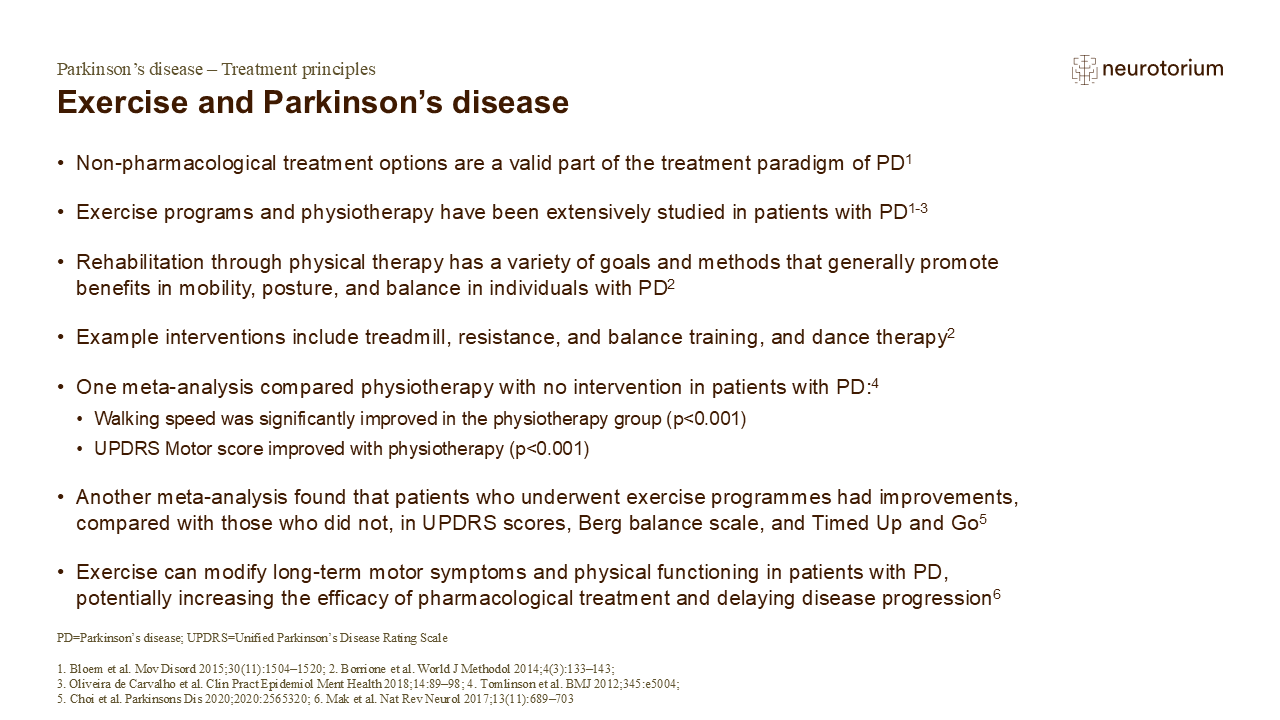
With the exception of tremor symptoms, tailored exercise and physical activity therapies have been shown to improve all the prominent motor symptoms experienced by individuals with PD.2 In order to increase adherence rates, the patients themselves should choose a program of exercise they would find the most enjoyable or sustainable.2 Indeed, patient education about the benefits of an active lifestyle is important.2 The weekly recommended level of physical activity (PA) for patients with PD is 150 minutes of moderate-intensity PA, or 75 minutes of vigorous-intensity PA.7
References:
1. Bloem BR, de Vries NM, Ebersbach G. Nonpharmacological treatments for patients with Parkinson’s disease. Mov Disord 2015; 30 (11): 1504–1520.
2. Borrione P, Tranchita E, Sansone P, Parisi A. Effects of physical activity in Parkinson’s disease: a new tool for rehabilitation. World J Methodol 2014; 4 (3): 133–143.
3. Oliveira de Carvalho A, Filho ASS, Murillo-Rodriguez E, et al. Physical exercise for Parkinson’s disease: clinical and experimental evidence. Clin Pract Epidemiol Ment Health 2018; 14: 89–98.
4. Tomlinson CL, Patel S, Meek C, et al. Physiotherapy intervention in Parkinson’s disease: systematic review and meta-analysis. BMJ 2012; 345: e5004.
5. Choi HY, Cho KH, Jin C, et al. Exercise therapies for Parkinson’s disease: a systematic review and meta-analysis. Parkinsons Dis 2020; 2020: 2565320.
6. Mak MK, Wong-Yu IS, Shen X, Chung CL. Long-term effects of exercise and physical therapy in people with Parkinson disease. Nat Rev Neurol 2017; 13 (11): 689–703.
7. Bouça-Machado R, Rosário A, Caldeira D, et al. Physical activity, exercise, and physiotherapy in Parkinson’s disease: defining the concepts. Mov Disord Clin Practice 2019; 7 (1): 7–15.